Welcome to ScapeCrunch

We are ScapeCrunch, the place where planted aquarium hobbyists come to build relationships and support each other. When you're tired of doom scrolling, you've found your home here.

Journal Trying to make a high-end aquascape from scratch

  • Thread starter Thread starter gjcarew
  • Start date Start date
  • Tagged users Tagged users None
Joined
Nov 11, 2022
Messages
283
Reaction score
799
Location
Renton, WA
Hey folks, this marks the first time I've had more than one journal at a time, but I'm beginning work on a new 120x60 low-iron, rimless aquascape. I've been inspired by Hendy8888 and @Naturescapes_Rocco to try to make a really high quality stand. I have tried making a stand before, but it was a 2x4 stand with reclaimed wood facing, and it ended up looking pretty amateur. I'm trying to go high-end on this one in part because I want to be able to build cabinets for various projects around the house, and my wife will be less upset if I botch a fish tank stand than if I botch a new kitchen build.

I love seeing these stand builds, but they've always seemed somewhat under-documented to me. So this is starting from the very beginning - the design.

Under the influence of Rocco I did some 3d modeling for the tank. The pictures are a front view, one without the top sheet one, and one without the doors on. I used Shapr3d, which is free for one project. Let me know what you think of the design, and if there is anything I could work on!
 

Attachments

  • Screenshot 2025-10-17 at 9.29.14 PM.webp
    Screenshot 2025-10-17 at 9.29.14 PM.webp
    9.8 KB · Views: 18
  • Screenshot 2025-10-17 at 9.29.50 PM.webp
    Screenshot 2025-10-17 at 9.29.50 PM.webp
    47.5 KB · Views: 18
  • Screenshot 2025-10-17 at 9.31.08 PM.webp
    Screenshot 2025-10-17 at 9.31.08 PM.webp
    18.7 KB · Views: 19
Well. You can do this! Desire is the key. You can get the skills to do this.

And to give you some inspiration…


Part 1 of a 5 part series.. hardwood raised panel matching stand canopy with counterweight to raise up off the tank and side hutches.

Korbels on the stand…

I can appreciate the work this guy did and I havethe skills and the chops to pull it off but the style doesnt suit my tastes though I can appreciate it. I prefer more of a late 19th century farmouse style myself…

I used to build wooden boats and have a decent amount of woodworking skills. Happy to be of any assistance if you want to reach out…
 
I 'm not exactly a skilled woodworker. But have recently attempted 2 similar stands myself. The one big tip I will provide, and you may already know this, don't buy the plywood from a big box store like Home Depot or Lowes if you can avoid it. Find a specialty lumber yard that sells true cabinet grade plywood. You'll pay more, but have far better quality (flatter) wood to work with which makes a huge difference when you're not just screwing it to a 2x4 skeleton.
 
Hey folks, this marks the first time I've had more than one journal at a time, but I'm beginning work on a new 120x60 low-iron, rimless aquascape. I've been inspired by Hendy8888 and @Naturescapes_Rocco to try to make a really high quality stand. I have tried making a stand before, but it was a 2x4 stand with reclaimed wood facing, and it ended up looking pretty amateur. I'm trying to go high-end on this one in part because I want to be able to build cabinets for various projects around the house, and my wife will be less upset if I botch a fish tank stand than if I botch a new kitchen build.

I love seeing these stand builds, but they've always seemed somewhat under-documented to me. So this is starting from the very beginning - the design.

Under the influence of Rocco I did some 3d modeling for the tank. The pictures are a front view, one without the top sheet one, and one without the doors on. I used Shapr3d, which is free for one project. Let me know what you think of the design, and if there is anything I could work on!
I love it! And I love seeing someone else give Shapr a try. Very good intro modeling software.

I would recommend tripling or quadrupling the thickness of the front support beam; gluing 3 or 4 layers of plywood together creates a beam that is stronger than a pure wood beam, as long as you used a ton of glue and some fastners/screws along the way. It won't take up too much of your tank space and will give you total piece of mind.

But this is perfect. The back panel, and the front "reveal", both act as "roll stops" to prevent the stand from folding left or right, and it'll definitely be able to hold your aquarium if you're using something like 3/4" Baltic Birch plywood from a good wood supplier (like @techman81 said). I love that you have the bottom lip in the front; use a good caulk sealant in those corners, and you will have a waterproof "tub" to hold water, and trigger water alarm sensors, long before you ever flood your house! You won't regret that at all.

Make sure you measure and model the height of the RIM of the tank. I would recommend not going much higher than 2-3" below your armpit, or maintenance becomes an annoying chore that you need a step stool for. And I'd recommend using Blum Full Overlay hinges for the doors, they're rock solid. Use the Kreg cabinet jig for easy installation.

Let me know what questions you have or tools you might need, and best of luck! This is awesome.
 
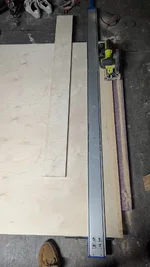
First step was getting accurate, repeatable cuts. So I sprung for a kreg straightedge for my circular saw since I don't have a table saw. 1000005077.webp1000005076.webp
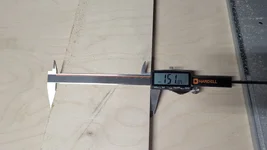
First cut was wide by 1.84 mm, but straight along the length (under .5 mm deviation along the length of the cut). I think I must have mis-measured the width of the guard on the circular saw, so I'll just measure ~2 mm shy on the next cut.

Luckily the dimensions for this piece are not critical, so this is good enough. But I want to make sure everything is bang on accurate so everything lines up level and square when it's time for the glue-up.

I ordered the tank from Aqua Rocks Colorado during their sale, it's 120x60x50 cm. I'm super stoked for it to arrive, and highly motivated to get this stand completed!
 
Ok, so this is going to seem painfully obvious to the woodworkers here. I've been getting some cuts that are ~2 mm off occasionally. I thought maybe I am bad a measuring, maybe my straightedge is vibrating out of position... Well I finally figured out that you need to account for the kerf differently depending on which side you set the straightedge from.

So let's say I need a 1000 mm cut, and the guard is 100 mm, and the kerf is 2 mm. If I set the straightedge on the offcut side of the cut, I need to set it at 1102 mm (cut length + guard + kerf).

But if I set the straightedge on the side I wish to keep, I need to set it at 900 mm from my measuring point, since I don't want to include the width of the kerf in that cut.

Basically I've been adding and subtracting 102 assuming that was a fixed distance, not considering which side I'm cutting from.

I knew I was gonna make some dumb mistakes on this project, but I don't think anything is significantly derailed. The back sheet is 2 mm short, but I don't think that makes enough of a difference to warrant re-cutting it considering the cost of the materials. Any thoughts?
 
My thoughts are that it happens to everyone at some point! Depending on how the assembly is designed, it will either ruin the stand or it will be fine.

In Shapr, you can do math within measurements/lengths themselves:

1762009818550.webp

I'd use this feature to "re-build" your tank digitally with the actual panel measurements you now have, and see if it messes things up. Chances are you might need 1 more panel of plywood to fix things, but like I said, it depends on the panels you cut short!
 
Ok, so this is going to seem painfully obvious to the woodworkers here
Well, you just paid your tuition to learn this lesson the same way most experienced woodworkers learned it.

And sometime experienced woodworkers get an unexpected refresher lesson on it too….

The back sheet is 2 mm short, but I don't think that makes enough of a difference to warrant re-cutting it considering the cost of the materials. Any thoughts?
Strength wise it isnt an issue. Its a question if the aesthetics or knowing it is off is going to bother you.
 
If you find any steel-toed slippers let me know. Bold of you to assume I have a shop, this is all taking place on the floor in my gear storage room
OSHA has no jurisdiction so long as you are the sole employee.

I used to build wooden boats in my garage and I have been known to venture out there and have done some work using the same slippers myself…
 
It would be really nice if after painting the bottom of the stand was waterproof (or at least water resistant) so I can throw some water monitors in there for peace of mind
As a boat builder we would just paint some epoxy on the two pieces of ply where there was a gap, Mix some sawdust into more epoxy to make a putty, use a toungue depressor to slather on a nice rounded fillet of epoxy putty into that gap and lay a strip of fiberglass tape over it and paint more epoxy…

Waterproof, incredibly durable strong bond, and a rounded edge which is easier to clean…

Can laminate fiberglass cloth over the ply bottom and sides to make a truly waterproof cabinet bottom should you care to….
 
Got all the cutting finished tonight! Assembly is up next.

How do you know how many pocket screws are needed? Nothing should be relying on the strength of the screws (everything is structurally supported by plywood), so does that mean it's just a screw in each corner? Or should I be adding them at regular spacings?
 
How do you know how many pocket screws are needed? Nothing should be relying on the strength of the screws (everything is structurally supported by plywood), so does that mean it's just a screw in each corner? Or should I be adding them at regular spacings?
Screws should mostly be used to provide clamping pressure while the glue sets up. Makes for better bonding. 6-9 inches isnt a bad metric. Closer if you see gaps.

After glue has bonded well, screws continue to add resistance against shock loading.

Everything is supported by plywood vertically. Glueing and screwing is all about preventing the plywood panels from moving out of alignment…. Racking forces…
 
Last edited:
I used screws pretty liberally (like every 2-3 inches on corners that were important to be pulled flush together), and as much glue as I was willing to clean up during squeeze out!
I think wood glue and duct tape both deserve consideration as greatest inventions ever.
 
I wanted to do a lot of documentation on the stand build because most stand builds I've seen show a couple pieces of plywood, then a finished stand. Well, I've figured out a new way to botch things.

I was using a corner clamp to align the corners before screwing two panels together. Well it turns out that when you screw one board to another with pocket screws, it draws the board in the direction of the pocket hole. So I ended up with a board that was bowed out and misaligned in the middle.

I got a big 50" bar clamp to mitigate this problem. If anyone has another solution, again please let me know.
Well, you just paid your tuition to learn this lesson the same way most experienced woodworkers learned it.

At the rate I'm"paying tuition" I'm gonna need to take out student loans pretty soon 😅
 
Back
Top