Welcome to ScapeCrunch

We are ScapeCrunch, the place where planted aquarium hobbyists come to build relationships and support each other. When you're tired of doom scrolling, you've found your home here.

Journal UNS 150U - Nature Aquarium

Joined
Jan 8, 2026
Messages
18
Reaction score
70
Location
Nokesville, VA
The adventure begins...again. After a substantial absence from the hobby, I dunked my toe back in last fall with a small 60F shrimp tank, a Chihiros WRGB slim, and a Chihiros CO2 (citric/baking soda) system. A lot has changed since I started this hobby in the 90s, and it's been about 20 years since I tore my last tank down. 'Aquascaping' per se wasn't as much a thing back then. I didn't know anyone running CO2, and LED lights didn't really exist. The 60F was fun, and the shrimp seem happy, but I have been itching to get to building something with more elbow room.

I did happen to find a pic of my old 75 gallon bowfront tank a few weeks ago that was taken just before I tore it down prior to a big move. It ran great for 7 years. Was a simple low tech setup, with one hunk of driftwood, no rocks, plain gravel (no soil) a lot of simple plants (the sword plants did great), and some peaceful fish. Algae wasn't an issue, filtration was pretty subpar by current standards, but the tank did well despite that, and algae wasn't really an issue. Aesthetically blah by today's standards, and certainly not my goal for this build, but I remember being proud of how well this tank ran back then, and wasn't too demanding. Important as my life was very hectic back then.

IMG_1702.webp

So, the tech plan so far for the new 150U:

UNS 150U Tank & Stand
Chihiros Vivid 3 x2
Chihirios Vivid 3 Shades x2
GLA PRO-DS-1 Dual Stage CO2 System (Modular)
Chihiros
Auto Dosing System (4 doser)
Chihiros Dosing Flow Adapter
Oase Biomaster 2 Thermo 600
Oase Biomaster 2 Thermo 850
ARC RBG Backlight Screen
ARC Stainless Yugang CO2 Reactor (Large)

I ordered the tank and stand from UNS, and to my amazement, despite the worst mid-January winter storm we had in some years here, it was delivered on time by the freight company. I do not recommend trying to move a 5ft wide 400+lb tank and stand across snow and ice, down a slope, into to basement. Very thankful to have a tractor with forks, but still was a bit stressful getting this into the house. Miraculously we got it in the house in one piece, and I seriously questioned ever getting a tank larger than this in the future!

delivery.webp

It did require disassembly outside the basement door to actually get it into the house around a berm of snow, along with some extra muscle from a few friends. (This was originally meant to be a 120P, until I realized the hardscape plan I had wouldn't quite fit. What's a another foot in length? :LOL:)

1000022407.webp

Just getting the tank through the snow and ice was enough, and the base cabinet and tank just sort of landed in the room, and stayed there for a few days while devising a strategy for the next step. After recruiting a tall and strong friend, and sourcing some of those giant suction cup handles you use for moving shower glass walls, a few days later the tank was finally hoisted up onto the base.

As there is a dropped ceiling in the basement my plan was to hang the lights directly above the tank from the ceiling, rather than using a light stand. A few tiles were removed to investigate the structure above, and with some 2x4 extra bracing for the anchors, as none of the joists were in quite the right spot, two Chihiros Vivid 3 lights were installed directly above the tank. At this point I discovered that none of the electrical circuits in the basement were GFCI protected, so obviously that was immediately remedied. Too much gear and too much water to mess around with unprotected circuits.


1000022541.webp

With the ceiling open, I decided to run the lighting cables over the top of the wall to the left of the tank, and down into the mechanicals room there. The advantage being that the power cords are hidden from view after going through the ceiling tiles, and it's two less large power sources cluttering up the cabinet under the tank. Had to add an outlet in that closet, but I like how it turned out.

With the tank in position and leveled, and the lights finally installed, the next big issue is water. The well water here is liquid limestone. That was the initial mistake I made with the shrimp tank. Sure, neocaridina like hard water, but not THAT hard, and I quickly had to shift to remineralized distilled. I knew before even getting serious about planning this tank that the only reasonable option, for any future tanks here, is RO. The well water might be fine for Malawi Cichlids, but that's not my plan for this tank, but it will be great to have flexibility going forward. It's a big glass box, at just over 140 gallons, and it won't be the only one here (I hope), so the water part I want to get right from the start, and to make it easy to do water changes. The basement is a walkout, so draining water during water changes will be easy, and I would like to make filling it just as easy. I sourced two 70 gallon storage tanks for the RO water from Northern Tool, and ordered a Vectra S2 pump which will help with transfering water between tanks, as well as pumping it out through a hose to the aquarium(s) during water changes. Forgot to take a pic when I was done, but the pvc is all glued up now. I will finish installing the RO unit this weekend.

20260301_152236.webp

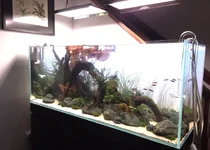
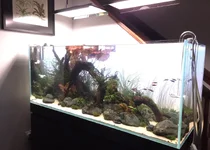
So, aquarium set up, lights in, and RO system with storage in progress. Next up? The exciting part. Hardscape! I have been hoarding Manzanita, Hakkai stone, and substrate for several months, so I'm excited to move on to the next step! Tank so far pictured below (although I have already removed the privacy film on the back in favor of adding the ARC RGB light screen in part due to the stair rail being visible and distracting. First screen was damaged in transit, so waiting on a replacement).

20260215_171005.webp
 

Attachments

  • 20260129_115608.webp
    20260129_115608.webp
    463.5 KB · Views: 5
Big jump from a shrimp tank to this. Awesome! Looking forward to following.
It is a bit, but I consider it more of a step forward from the old 75 gallon. I couldn't opt for a larger tank than that at the time, because I had to had to haul all of my water in 5 gallon water cooler bottles. Same issue there (I was living in California at the time) with my tap water being very hard. A 50% water change was a workout, so a tank that size was about my limit. Part of my issue with my 60F smaller tank is it is more frustrating to maintain than a larger tank (well, that was also on me for my plant choices). The plants are growing at light speed, which is great, and the reds are popping, but I am learning to have a disdain for stem plants and moss in tight spaces. After I get this 150U into a dark start, I plan to rescape the shrimp tank into mostly slower growing epiphytes. On the upside I did learn to space my stems out further next time, and don't put moss where the scissors can't reach!
 
I have been sitting on the hardscape long enough. Manzanita and Hakkai stone, ADA Amazonia v.2 and La Plata sand. Layout somewhat evolved due to the tank being viewable from the right side as well as the front, and I am trying to leave some swim space for the fish as the tank matures after planting. The gaps between the vertical rock and wood will be filled with some epiphytes (either narrow leaf java fern or hygrophila pinnatifida UK as I have some extra. Now to finalize the rest of the planting plan, and finish the RO setup. Will dark start before planting, so I get to live with this for a bit and decide on any changes before committing to planting.

20260303_193040(1).webp

1000023119.webp

Top down view. You can see there's a sand channel that runs behind the rocks on the right side. There is actually an aquasoil 'island' in the middle of that arched wood on the right, so I can bring a few smaller plants forward. I might regret this much sand...we'll see!

20260302_193848(1).webp
 
Love it! Did you get the Hakkai stone from ARC? Some really nice pieces.
I did get it from ARC. My Fed Ex guy, Joshua, probably hated me. Damion sent me some photos of what he was shipping in advance, but I pretty much left it up to ARC, I just specified rock size. So glad there weren't too many big stones, I really have a whole new respect for just how dense this rock is, but I love the look. I picked up the Manzanita first, so I had an idea where I was headed, and let the rock decide the rest once I received them.
 
I did get it from ARC. My Fed Ex guy, Joshua, probably hated me. Damion sent me some photos of what he was shipping in advance, but I pretty much left it up to ARC, I just specified rock size. So glad there weren't too many big stones, I really have a whole new respect for just how dense this rock is, but I love the look. I picked up the Manzanita first, so I had an idea where I was headed, and let the rock decide the rest once I received them.
About how many pounds is that? I'm probably going to do an Iwagumi at some point and want to use it.
 
About how many pounds is that? I'm probably going to do an Iwagumi at some point and want to use it.
I had to go back and look at my orders. Looks like a total of 125 lbs: Started with the mixed and small, and then did a second shipment for the rest. I used all but one small rock!

Large (9-12 inch)=30lbs
Medium(6-8 inch)=30lbs
Mixed (6-12 inches)= 45 lbs
Small (2-5 inch)=20lbs.
 
Finally completed the RO/DI system today, along with getting the RO storage situation sorted out, and now have the ability to pump the water from storage out to the tank(s)! Although this isn't scape-specific, I am posting this update because I see a lot of info out there about the benefits of RO for aquarium use, but figuring out components, and configuring a system together can be pretty intimidating at first, especially for working with larger aquariums. This is not 'the' solution, but it is a solution, so I am sharing for anyone else that my find this helpful.

Honestly, I expected to have this project finished last weekend, but on the initial system test, the incoming PSI from the house water supply was so low that it would have taken a week, and generated a lot of excess waste water, just to fill one of the RO storage tanks 😞

20260308_141526.webp

Less than 50 PSI is not recommended, so 32 PSI just wasn’t going to cut it. I suspected this might end up being the situation, but it was nothing that a booster pump couldn’t fix. I just wasn’t going to invest in one unless it was necessary. Although the booster pump cost another $140, I know it will be worth it to have RO here on demand. As of this evening, PSI is now running at 88, and once these two storage tanks fill I will dial that down a little to around 85 PSI, just to avoid pressure-related leaks (which can potentially occur with PSI >90), but so far, so good, as the system is currently producing about 12 gallons an hour.

1000023275.webp

For reference, I put the RO storage system together much the same as this Waterbox one:

RO/DI and Water Storage for Large Aquariums

It is a nice straightforward setup, and has the benefit of being scaleable. Rather than use one large storage tank, two smaller tanks with the capacity to transfer water between them, saved a lot of shipping fees, as smaller storage tanks were much more economical to ship. Each of these tanks holds 70 gallons. I was able to ship them both for a mere $42, and they were delivered via FedEx home delivery (I sourced the tanks from Northern Tool). My first shipping quote for a larger tank was almost $600 due to the high cost of freight shipping.

1000023283.webp

So, as I have two smaller tanks, that gives me options. While initially I will just be mixing GH+ into the water for this scape, and I could just mix that in the aquarium and make the filter flow do the work, you never know where you may end up in this hobby. I don't plan to ever do marine tanks, but I can do pretty much anything now. Not to mention, this build is a 142 gallon tank, so 30-50% water changes are not insignificant, and it takes time to make enough RO. It has the advantage that I can balance the GH in the tank in advance, and not risk overshooting in the scape. There is also a significant risk of this 150-U build not being the largest tank I will ever own 😆

I needed to set up a transfer pump anyway to pump the water through a hose out to the 150-U, so between an RO storage solution, and water transfer, I was already mostly at this setup anyway. It will give me the option to use the right side tank to premix GH, or GH/KH salts in large volumes depending on the scape if I so choose, or just store 140 gallons of plain RO/DI at a time. The capacity of this RO system is 150 gallons per day when running at optimum efficiency, so it will still take a day to make enough water for the initial tank fill. The pump can transfer water from the left to right tank, and then circulate the water through the right side tank in a repetitive closed loop for additive mixing, without having to stand there and stir salts by hand (especially handy for multiple tanks with the same water requirements). I will keep the left side tank as straight RO/DI storage for things like ATO reservoirs, or as emergency water in the event of an extended power failure, or well pump failure, for my other (non-aquatic) critters. The ‘faucets’ below each tank also allow me to take smaller volumes as needed for other smaller tasks.

For anyone that is curious the ‘engine’ is an inline Vectra S2 DC pump. It doesn’t need to be huge for this application, and has the benefit of being app controllable (switching the pump on and off for example while standing in front of the aquarium, and not having to run back and forth).

1000023284.webp

As I mentioned, the point of all this (other than RO storage) is to get the water from the storage tanks to the aquariums. We just finished redoing the basement floors, because the entire basement flooded last July during a severe storm that dumped 3+ inches of rain in about 55 minutes and warped the laminate flooring the previous owners installed. While I intentionally switched out the flooring this winter to something much more water-resistant (both for future flooding potential, but also in case of spills during water changes), I don’t really want to be manually winding up a hose and dragging it across the tile floors every time. I had seen Juris Jutjajev use a retractable hose reel for a tank in one of his videos, and made a mental note of it, I just needed to find one that was floor mounted due to some shelving obstacles in this mechanicals room.

20260314_162321.webp

I went with a retractable floor model from Giraffe Tools, and I will put it to the full test tomorrow when I set up the quarantine tank. It is a standard ⅝” hose dimension, about 92ft in length, and it can be stopped at any desired length, and retracted back into the housing easily. The only caveat is that I will need to anchor it to the concrete slab floor (Giraffe does provide the concrete anchor bolts with this unit).

With the water supply situation resolved, now I am just waiting on the tanks to fill so I can get this dark start underway. In the time it took me to get this set up I probably could have done a dry start before the dark start! 🤪 Oh well, at least it's done now, and LOOK...no more liquid limestone! 0 TDS is such a beautiful sight!

1000023280.webp
 
Nice. Just thought I would mention about the use of the booster pump. For all booster pumps that I'm aware of the manufacturers tell you never to run them for more than something like 2 hours at a time, then to have a cooling period. My booster pump certainly gets noticeably very warm after 2 hours usage. This is a pain when you have lots of RO to produce.
I need to produce around 350 litres of RO a week. My answer was to use a small fan to cool the booster pump. I can use it constantly now and it doesn't get warm at all. I have been using it constantly for around 2 days a week for around a year now, so I am pretty confident that this is not hugely affecting the lifespan of the pump. it makes producing RO so much more convenient too.
 

Attachments

  • IMG_7059.webp
    IMG_7059.webp
    131 KB · Views: 4
Nice. Just thought I would mention about the use of the booster pump. For all booster pumps that I'm aware of the manufacturers tell you never to run them for more than something like 2 hours at a time, then to have a cooling period. My booster pump certainly gets noticeably very warm after 2 hours usage. This is a pain when you have lots of RO to produce.
I need to produce around 350 litres of RO a week. My answer was to use a small fan to cool the booster pump. I can use it constantly now and it doesn't get warm at all. I have been using it constantly for around 2 days a week for around a year now, so I am pretty confident that this is not hugely affecting the lifespan of the pump. it makes producing RO so much more convenient too.
Thanks, Hamfist. I had noticed that this Aquatec 8800 does run a bit warm after a while, although I purchased this one because it is supposed to be rated for continuous use. I do like the fan idea, though, it certainly wouldn't hurt! Also a good thing for anyone to be aware of that is considering installing their own RO system. I didn't even know RO systems might need booster pumps before I started this project, let alone that some may be rated for intermittent use only. So much to learn! 🤓

The Aquatec 8800 series pump is designed for continuous duty in RO/DI systems, hydroponics, and misting applications. It is a durable pump designed for over 30,000 operating hours and is capable of handling consistent, long-term operation, making it ideal for high-flow RO systems up to 150 GPD and high-demand applications.
 
Thanks, Hamfist. I had noticed that this Aquatec 8800 does run a bit warm after a while, although I purchased this one because it is supposed to be rated for continuous use. I do like the fan idea, though, it certainly wouldn't hurt! Also a good thing for anyone to be aware of that is considering installing their own RO system. I didn't even know RO systems might need booster pumps before I started this project, let alone that some may be rated for intermittent use only. So much to learn! 🤓

Interesting, yes the 8800 claims to be designed for continual use. A very useful feature. The Aquatec series are a bit more expensive than the pump I have. I might have been tempted had I known the difference at the time. I remember when I was buying (post COVID) there seemed to be a general shortage nationally in the UK of booster pumps and I had to take what I could find. Its easy enough to run a fan at it anyway. It looks like you are all sorted though.
 
Back
Top