Welcome to ScapeCrunch

We are ScapeCrunch, the place where planted aquarium hobbyists come to build relationships and support each other. When you're tired of doom scrolling, you've found your home here.

Starting from low pH

  • Thread starter Thread starter Chimera
  • Start date Start date
  • Tagged users Tagged users None
Joined
Jun 20, 2026
Messages
48
Reaction score
104
Location
Australia
Hi everyone,

I’m still collecting gear for my first tank in over a decade. We are in a new home and capture our own rainwater supply from the roof. I expected it to be soft and a little acidic but I have just tested it now that I have my new Apera PC60 pH meter and salifert kits.

Temp 13C
pH 5.15
Cond. 22um
TDS 16
Sal. 0.001ppt
KH and GH less than 0.5 as non-result with a half titrate.

I did wonder if the pH may be a little lower than expected due to CO2 dissolved in the water so left a sample to off gas overnight. Only made a difference of 0.2 units.

Previously my water has been pretty average, so I’m lucky to have a great source falling from the sky here and will obviously need to “remineralise” or “mineralise” this with CaSO4, MgSO4 for target GH and add some NaHCO3 to raise the KH. My understanding however, is that while increasing KH to say 1dKH will give the tank some buffering potential and stability, it won’t necessarily increase pH.

Do youu think this pH will be too low? I know it would be considered outside ideal in terms of nutrient availability for plants.

Thoughts?
 
Raising dKH will raise the pH.

I am not sure where you heard that low pH is considered outside ideal in terms of nutrient availability for plants.

There are loads of people who run planted tanks at essentially zero dKH and very low pH. In fact, many plants prefer it.

And I wouldn't worry about buffering potential and stability. I run my tank at zero dKH and pH is very stable. pH crash from low dKH is mostly myth that still gets repeated even though so many have run low pH tanks successfully for years.

pH crash is almost always tied to very poor maintenance. In a well run tank it's absolutely nothing to worry about.
 
Hi everyone,

I’m still collecting gear for my first tank in over a decade. We are in a new home and capture our own rainwater supply from the roof. I expected it to be soft and a little acidic but I have just tested it now that I have my new Apera PC60 pH meter and salifert kits.

Temp 13C
pH 5.15
Cond. 22um
TDS 16
Sal. 0.001ppt
KH and GH less than 0.5 as non-result with a half titrate.

I did wonder if the pH may be a little lower than expected due to CO2 dissolved in the water so left a sample to off gas overnight. Only made a difference of 0.2 units.

Previously my water has been pretty average, so I’m lucky to have a great source falling from the sky here and will obviously need to “remineralise” or “mineralise” this with CaSO4, MgSO4 for target GH and add some NaHCO3 to raise the KH. My understanding however, is that while increasing KH to say 1dKH will give the tank some buffering potential and stability, it won’t necessarily increase pH.

Do youu think this pH will be too low? I know it would be considered outside ideal in terms of nutrient availability for plants.

Thoughts?
Agree with @GreggZ and @renesis.

Also important to add:

pH probes are not reliable at zero KH/low TDS.

The nature of how glass pH probes work means that they do not give accurate pH readings at low/zero KH. It's the same reason why you can't take a true pH reading of pure RO water; if you try, it will swing pretty wildly depending on temperature, contaminants, atmospheric CO2, etc.

pH really isn't a concern with our tanks. Decades of pseudo-hobbyist nonsense has left the impression that we need to worry about CO2 swings, that pH crashes are a thing, etc.

It rarely happens. My best tank ever had a daily pH swing of over 1.5pH, and sat at 5.1pH at max CO2 injection:
1784311494872.webp
Again, max CO2 injection of ~5.1pH, daily swing of 1.5pH. Livestock happy, breeding, plants the healthiest they ever were.
 
Ditto everything everybody else has said. The pH of basically RO water (dGH and dKH <1) is almost completely down to the levels of dissolved CO2 (and maybe certain organic acids). That will be meaningless as soon as you GH-remineralise it. And even more meaningless once you KH-remineralise it.
If you have <1dGH and < 1dKH water then once you GH-remineralise it to around 4-5 dGH then that will serve you very well for a planted tank of almost any description. pH variability or swinging in itself is almost irrelevant. pH swinging is only an indicator of other chemicals swinging. If it indicates CO2 variation causing the pH swing then its generally not a problem. However, if a pH swing is due to KH swinging then it nay well be a huge problem.

KH (and to a lesser extent GH) stability is the main parameter to be focussed on. Primarily for shrimp health, but also for plant health.

I, like many others here, run zero KH tanks (with CO2) and have no problems with plants, fish or shrimp. Each species of shrimp and fish will have a maximum CO2 level it is happy with but so long as you do not abuse this all will be fine.
 
I'll let Hamfist reply too, but I've had zero issues keeping and breeding both Neos and caridina in zero KH with CO2!
I may try and clear my ramshorn snails from a couple of tanks so I can give it a try. Thanks!
 
That’s awesome info everyone.
I should have realised about the pH meter issues such soft water. I’ll have another tonight and check with my kit.
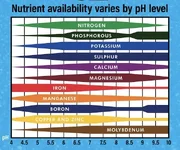
@GreggZ the question about pH and nutrient availability came from some common soil and biology info, but perhaps it’s actually where pH is a reflection of cation exchange.
I think I saw a chart the same as the one below in one of @Naturescapes_Rocco journal.
IMG_2094.webp

The above is certainly true in natural aquatic ecosystems. The ANZECC guidelines for protection of aquatic ecosystems actually set 2 maximum values for metals such as aluminium. In lower pH receiving environments, a stricter limit must be placed on discharges of aluminium because the metal becomes more available. On basic environments however, most species can tolerate a higher level of aluminium entering the system.
Perhaps this is not actually the pH itself, but pH is in fact a proxy for another process that is going on????
In any case I’m about to see how it all goes, my tank will be here next week and from there on it’s stand building!

Cheers
Chimera
 
Last edited:
Neocaridina included?

I only have amanos in my big CO2-injected tank. However I keep both Caridina and Neos in zero KH low tech tanks. THe Neos breed very slowly but seem to live decent length happy lives, and don't seem to succumb to parasites etc. so I don't fee that I am abusing them. Neos in harder , alkaline water will absolutely thrive and breed to biblical proportions. Its true that keeping them in zero KH water is not like that, which may well be a good thing !
 
Neocaridina included?

I'll reply with a little more detail in that I find specific lines of Neos to be extremely variable in terms of how they will handle low KH (and likely low GH too, although I have not experimented with that).
Some Neos seem to adjust fine to zero KH, and once they finally start breeding, the offspring can do very well, and do appear to be better adapted to low KH living than their parents. On the other extreme, I have had more than one line of Neos that simply all died within a week and I am convinced it was down to low KH. I acclimated all shrimp super slowly and the tanks were all very mature with superbly controlled NH3 and NO2, so it really had to come down to KH as being the problem.
If possible, try and source some Neos from a lower KH breeder. If that isn't possible then with a little perseverance you should get to a healthy self-sustaining colony eventually with most lines, so long as you can start them breeding at all. I have found that some literally will not breed at those KH's though.
 

Top 10 Trending Threads

Back
Top