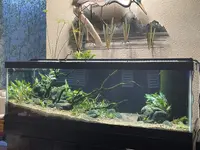
I'm surprised that plant uptake of CO2 was so inconsequential. Is this with an inert substrate? What kinds of plants and how is their growth? Any livestock? I'm wondering if perhaps there isn't much endogenous CO2 generation in the tank.
Hi,
The CO2 uptake by plants is definitely visible on the monitoring graphs, so not inconsequential as you might think.
But what I ment to say the effect of decent aeration (with ambient CO2 levels between 400 and 1200
ppm, monitored as well) on the aquatious CO2 level is clearly stronger than plant uptake during the day.
And that’s why I aerate the tank, as my hypothesis is that in a fully planted tank there is too less CO2 dissolved to support them during the entire day. So I’m a supporter for increased CO2 diffusion by aeration and strong (surface) flow.
And the effect of the aeration is clearly stronger than endogenous CO2 generation (clearly visible and the strongest during the night) as well.
I could show you some graphs and explanations for all these findings, but I rather write a separate article/thread for it.
I would agree if endogenous CO2 generation is bigger than in my tank, a siesta could help elevate CO2 level somewhat. I haven’t seen any measurements to support it though. Have you seen any? (I might shut down the aeration for a day and do a siesta to measure it.) But a siesta looks completely unnatural for me, why not decrease the light intensity to lower CO2 uptake?
Regarding your questions:
Substrate? Yes I have mostly inert gravel, but the substrate is more than 3 years old, full of gunk and sometimes it’s gets earth worm casting additions.
Plants? Fully stocked with mostly Bolbitis, Egeria, Nymphoides, Rotala, Cryptocoryne, Pogostemon Anubias and Lysimachia.
Livestock? Just 15x 4cm Tanichthys micagemmae, 300 Neocaridina shrimp and uncountable little snails in nett 550 liters.
I hope the respond isn’t too off topic. If so, let me know.
I'll start writing my own article, maybe my findings monitoring my tank will help others...