Welcome to ScapeCrunch

We are ScapeCrunch, the place where planted aquarium hobbyists come to build relationships and support each other. When you're tired of doom scrolling, you've found your home here.

how to dose an aquarium with dry chemicals ?

  • Thread starter Thread starter anewbie
  • Start date Start date
  • Tagged users Tagged users None
There's some anecdotal evidence of people using HCl to reduce Kh (and in turn, pH), but nothing too official.

pH is also reduced through Tannins, which I don't believe alter the Kh of the water.
You can change pH by adding acid (lower) or by adding KH (higher). Tannins and HCl are both examples of adding acids. so Ph goes lower. Alkalinity will be reduced, because you lowered pH by adding acid and it consumed some KH.

None of these things are acting like CO2 though, it does not consume KH by its presence in the water, as other acids do. More here: CO2 and pH: Understanding Henry's Law
 
Last edited:
Is there anything besides CO2 that works this way? I thought it was only CO2 that can technically "change" ph without changing alkalinity.

Yep the co2 won't affect the KH. I had a tank full of Seriyu and my PH literally went from 4 to 16 right before a water change with heavy co2 dosing. Most of the plants were epiphytes and seem unaffected. But I know others that have iwagumis with lots of hairgrass and they need to do lots of water changes to keep the KH down or the grass suffers.
 
Is there anything besides CO2 that works this way? I thought it was only CO2 that can technically "change" ph without changing alkalinity.
There are various ways - the water company adds something that raises ph to protect pipes but it gasses off - that's why if you set the water out in a cup for a day or two the ph changes. There are other additives but not sure of long term effects - of course you can add various acids to your water but if the kh is high not sure if it has much effect. I'm not an expert here on the impact of kh on ions which determine the acidic nature of the water or at least the stability of the acidic nature. I've had it explained a few times and it sort of floats in and back out. Also I'm not sure what the water company adds to raise the ph and why it dissipate over time.
 
I hate to bring this up again - but i think most people have said they only use kno3 and kh2po4; does that mean K2SO4 is unnecessary (I noticed that gla standard collection includes that with the other two) to add potassium but i get the feeling that most feel that Kh2po4 has enough potassium - is that correct ?
Btw it looks like gla iron mix includes other micro.
 
I hate to bring this up again - but i think most people have said they only use kno3 and kh2po4; does that mean K2SO4 is unnecessary (I noticed that gla standard collection includes that with the other two) to add potassium but i get the feeling that most feel that Kh2po4 has enough potassium - is that correct ?
Btw it looks like gla iron mix includes other micro.

If you dose EI guidelines I believe you're getting about 5-6 PPM of K (someone correct me if I'm wrong) every time you dose kno3 and kh2po3. So if you're dosing 3x per week you're getting a pretty good amount just from those two and probably close to EI guidelines. If you're using a booster you'll be adding even more. That's probably good for most situations, but if you want to be sure it wouldn't hurt to add more. If one has a high-energy, very stemmie setup than I could definitely see why one might want to add more separately.

If pinholes and yellowish leaves are the deficiency effect I've never seen it in my tanks, but I can't account for every stem out there.
 
bit of both - i will presume it has enough micro that i can just add a little more micro but not a whole lot.

What else does the GLA Fe contain? More than likely the micromix with the FE would be enough. Maybe others will chime. How many dose extra FE?
 
bit of both - i will presume it has enough micro that i can just add a little more micro but not a whole lot.
You really should try to be more specific than this line of thinking. We've given you the tools to properly determine what you need to add, how to measure it, etc... I wouldnt start going backwards by estimating things.
 
You really should try to be more specific than this line of thinking. We've given you the tools to properly determine what you need to add, how to measure it, etc... I wouldnt start going backwards by estimating things.
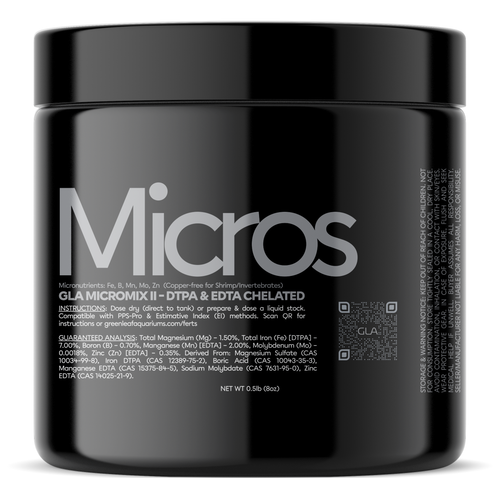
Because when i look at the scales et all - it seems very difficult to make and dose a correct amount of micro to around 1100 gallons of water on a weekly basis - i think can get pretty close to macro by using tbs and putting labels on the tuffleware; but to mix my own micro would require (unless i missed something); a whole new can of worms of constant micro mixing with a gram scale. When i looked at the label for gla fe it seems like it contained most of the micro in a premix can - how they make sure you get even distribution i'm not sure though i can speculate.

Let me rephrase this - i want to be 'good enough' without having major issues with the plants; as oppose to trying to get absolute maxium growth.
 
Last edited:
how they make sure you get even distribution i'm not sure though i can speculate.
This is exactly the issue with pre-mixes... they don't.

Even if you didn't want to make your own, just pick a micro mix and dose as directed. Using "a bit" of this and "a little" of that isn't going to work.
 
This is exactly the issue with pre-mixes... they don't.

Even if you didn't want to make your own, just pick a micro mix and dose as directed. Using "a bit" of this and "a little" of that isn't going to work.
But i am doing that; the fe sold on gla includes the micro mix so i will dose around what they recommend. If the plants go south i will evaluate and re-think. Part of the issue is i think the reason my plants do well is because of the frequent water change and the hardness of my tap water (gh 7/tds 120) as i currently dose around 1/4 of what most people on this forum recommend but don't have any obvious issues; naturally things will get tricker after i move as not only will the tanks be larger but i will be making hte water 30 to 60 percent softer via diluting tap with ro water. Also for the two large aquariums i will be using a drip system (approx 1.5 gallons per hour or 250 gallons a week).
 
But i am doing that; the fe sold on gla includes the micro mix so i will dose around what they recommend. If the plants go south i will evaluate and re-think. Part of the issue is i think the reason my plants do well is because of the frequent water change and the hardness of my tap water (gh 7/tds 120) as i currently dose around 1/4 of what most people on this forum recommend but don't have any obvious issues; naturally things will get tricker after i move as not only will the tanks be larger but i will be making hte water 30 to 60 percent softer via diluting tap with ro water. Also for the two large aquariums i will be using a drip system (approx 1.5 gallons per hour or 250 gallons a week).
I was referring to the comment you made above:

"bit of both - i will presume it has enough micro that i can just add a little more micro but not a whole lot."

If I were you, just stick to the micro mix you're using. If you want to add a little Fe, then add Fe, not a mix that has other stuff in it. You're asking for toxicity / deficiency issues if you are mixing different micros without knowing what you're adding.
 
I was referring to the comment you made above:

"bit of both - i will presume it has enough micro that i can just add a little more micro but not a whole lot."

If I were you, just stick to the micro mix you're using. If you want to add a little Fe, then add Fe, not a mix that has other stuff in it. You're asking for toxicity / deficiency issues if you are mixing different micros without knowing what you're adding.
The reason i was going to buy gla fe micro mix was because it is a solid and per dosage a lot cheaper than buying a liquid. The issue is i'm currently dosing ~170 gallons (120,40,29,29); I don't think it is economically substainable to dose the much larger aquariums with the liquid i buy - that was why i created this thread. My understand is gla fe is essentally the micro mixed in solid form.
 
The reason i was going to buy gla fe micro mix was because it is a solid and per dosage a lot cheaper than buying a liquid. The issue is i'm currently dosing ~170 gallons (120,40,29,29); I don't think it is economically substainable to dose the much larger aquariums with the liquid i buy - that was why i created this thread. My understand is gla fe is essentally the micro mixed in solid form.

Can you link the GLA FE product your referring to?
 
Can you link the GLA FE product your referring to?
Is the same stuff you linked earlier:

(if you read the jar inaddition to iron it includes mn,zn, cu, boron, mo); to be honest i'm not even sure if i need iron since none of my plants have yellow disease. My only complaint is have two plants that should be more red than they are (mermaid weed and Blyxa novo which should be a solid orange but is instead a decent green; but these might be light issue rather than nutrient issue.
 
Is the same stuff you linked earlier:

(if you read the jar inaddition to iron it includes mn,zn, cu, boron, mo); to be honest i'm not even sure if i need iron since none of my plants have yellow disease. My only complaint is have two plants that should be more red than they are (mermaid weed and Blyxa novo which should be a solid orange but is instead a decent green; but these might be light issue rather than nutrient issue.

Oh Ok it's the one I'm using. You kept saying GLA Fe and contains micromix. So yeah pretty much all of the micro mixes like CSM+B are very similar and they contain Fe. Just use that it will be fine. Yep the mermaid weed and blyxa is more a light issue. I have Mermaid Weed in two tanks and I dose the same. The one in the tank with 150 Par has much more red throughout it while the one in the 70 Par gets some read on top.
 

Top 10 Trending Threads

Back
Top