Welcome to ScapeCrunch

We are ScapeCrunch, the place where planted aquarium hobbyists come to build relationships and support each other. When you're tired of doom scrolling, you've found your home here.

Cheap CO2 Flow Meter Review

Does this mean if it's close to a solenoid, that the heat from the solenoid could throw the readings off? I wonder if that is part of the discrepancy I see between my flowmeter and the digital one.
Possibly, but I am not sure. I believe in any case, calibration would be useful if you care about absolute values. If you're interested in relative values, or just keeping flow constant less so.
 
Let me know if you need any help/code when the time comes. I have played around a lot with the calibration process and think I have it pretty settled now.
@JacksonL I was going DM you, but I figured seeing as there was interest from others, maybe public could be good.

So you saw my jerry rig earlier (its messy as hell, but at the moment I dont care, I just want to prove it works, can invest in neatening setup later) - but long story short, it all works (bus readings are good, home assistant integration works, etc) and now I need to calibrate.

With both caps on I'm getting the 32000 reading, which seems to be the standard 0 reading. So...any advice on how to calibrate now that its setup?
I haven't calibrated yet, but I also saw the 32k reading as baseline.

I was planning to calibrate by putting a syringe on the end after the needle valve, and timing how long it takes to fill, unless there's a better and more accurate way. Hopefully JacksonL has some insight.
 
Last edited:
I haven't calibrated yet, but I also saw the 32k reading as baseline.

I was planning to calibrate by putting a syringe on the end after the needle valve, and timing how long it takes to fill, unless there's a better and more accurate way. Hopefully JacksonL has some insight.
So using a syringe its pretty easy to calibrate - for air.

The question is what is an appropriate conversion factor from air>>co2 for this sensor. that I cant find anywhere. The closest I got is the AS200 manual from the same manufacturer that states correction tables, but I couldnt find anything stating that the AS200 uses the same sensor etc as the AFS01...I might just write an email to the manufacturer and try my luck there.

Have you had any luck on that? Or found any way to syringe co2 instead of of air maybe?
 
conversion factor is 0.74, from air to co2, for most of the thermal mass flow meters with co2 flow range below 5L/m.

for calibration, use another proven Mass flow meter with four times higher precision(four times lower error margin, or 4+ other flowmeters with the same error margin). Or use a weather balloon(perfectly round shape), to measure the increase of diameter(volume) against time for actual flow rate.
 
Last edited:
conversion factor is 0.74, from air to co2, for most of the thermal mass flow meters with co2 flow range below 5L/m.

for calibration, use another proven Mass flow meter with four times higher precision(four times lower error margin, or 4+ other flowmeters with the same error margin). Or use a weather balloon(perfectly round shape), to measure the increase of diameter(volume) against time for actual flow rate.
Thanks mate. Have made successful contact with the company as well. Pretty sure they'll confirm the 0.74.

As for a machine 4 times more sensitive...jeez luize. Not sure where I'm going to find that at a remotely affordable price. May use the balloon method.

In the end for my use case..it's mainly about consistency more than the actual measurement to be honest, as well as comparative changes. But of course the more accurate the better. Will investigate the balloon. Thanks!
 
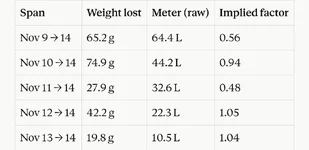
I haven't tried to calibrate yet, waiting on more flow data between the sensor and my load cell first as I've only had 2 full days of data without me flashing, and resetting the controllers or messing with it... But the early data suggests the afs01 is over reading by a little bit.

I'm seeing about 1.22 - 1.35 g/L usage between the load cell and the flow sensor. With pure co2 weighing ~1.83 - 1.98 g/L depending on temperature. So based on just the last 2 days, the cylinder lost 0.63-0.74 of what the flow meter reported. So I believe my meter is over reporting slightly. I'll update in a few days once I have more data.
 
Update on the ASAIR AFS01 CO₂ flow sensor

I've been experimenting with the AFS01 (0–200 SCCM) using an ESP32 and ESPHome, integrated into Home Assistant. After obtaining the latest May 2026 documentation directly from Aosong and conducting some calibration tests, here's what we've established:

1. Technical specifications
  • I²C address: 0x40
  • Supply: 5V (requires a level shifter with ESP32)
  • Accuracy: ±5% of reading; repeatability: ±1%
  • Pressure resistance: 0.3 MPa (3 bar), although gauge vs absolute isn't specified
  • Factory calibration gas: Air at 25°C and 1 atmosphere
2. Official SCCM conversion formula

The latest manufacturer documentation finally specifies the conversion:
Flow (SCCM) = (Raw Reading − 32000) / 140
The divisor of 140 applies specifically to the 200 SCCM model.

3. Experimental validation

I calibrated the sensor using a 20 mL syringe, repeating the exercise across multiple runs and integrating readings sampled every 500 ms.
My empirical conversion factors came out around 135–138, remarkably close to the manufacturer's official value of 140. This gives me reasonable confidence that the sensor measures air flow correctly.

4. CO₂ correction factor — the remaining challenge

I contacted Aosong directly. They confirmed that the AFS01 has never been calibrated for CO₂, so they cannot provide a correction factor. They did confirm that its response is linear.
I subsequently researched correction factors from Bronkhorst, Aalborg, Brooks, Teledyne Hastings, Renesas and Honeywell.
Several manufacturers converge around 0.70–0.75, with 0.74 being especially common for CO₂ relative to air/nitrogen. However, scientific studies demonstrate that the factor depends on the sensor's thermal design, so this cannot be assumed to be accurate for the AFS01.

For now, my provisional CO₂ formula is:
CO₂ SCCM ≈ ((Raw − 32000) / 140) × 0.74

5. Current status
The ESP32/ESPHome setup is working, with stable readings visible in Home Assistant. Air calibration is complete, but the 0.74 CO₂ correction remains unverified for the AFS01.
The outstanding task is obtaining a reliable reference measurement of actual CO₂ flow to establish the sensor-specific correction factor.

If anyone has independently calibrated an AFS01 using pure CO₂, I'd be very interested in comparing results.
 
So.....update...I couldn't get any better indication than the 0.74 conversion so I went with it.

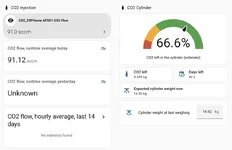
Reading is consistently about 92 Sccm which means

Hourly CO₂ consumption 5.52 L
Daily consumption 44.16 L
Daily CO₂ mass ~79.5 g

Which I thought was fascinating anyways. Whether it's 100% accurate I don't know.

But at least now I have a measured benchmark from which to increase/decrease AND to get the right level back again when I change canister.

Happy days.
 
This is something you could calibrate to, yes? A digital scale under the tank would tell you if you were dropping 80g per day 💯💯
That was exactly my thought as well! Yesterday I bought a scale for 20kg max with a 1 gram notation (would not dare to call it accuracy😉) to see how fast my bottle is decreasing in weight.
FYI I bought an AFS01 and its almost delivered. Can’t wait to fiddle with it.
 
Yes, it's doable, but my tank being in my cooler basement is subject to some more temperature drift, and I don't have a thermometer in that cabinet for correction. Also being attached to the same pcb that is controlling my co2 solenoids, Ro ato and mixing tank fill solenoids, it introduces noise when switching on / off. So I'm waiting for a longer time period of data to get a better read.

Screenshot_20261114_092105_Claude.webp

So not really useful data yet...

I've yet to do the syringe test too, waiting for when I pull my yugang to trim it since I'll have to shut off the flow then anyway.
 

Top 10 Trending Threads

Back
Top