
Welcome to ScapeCrunch
We are ScapeCrunch, the place where planted aquarium hobbyists come to build relationships and support each other. When you're tired of doom scrolling, you've found your home here.
Social Feed

Hello all,
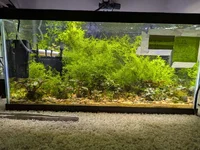
I am currently working on a little 10 gallon tank that is pretty heavily planted in a Dutch-style scape.
I am beginning to struggle with green spot algae on leaves and continue to get a little more each day. I also get a lot of green dust algae on the glass, but it sounds like that is pretty hard to avoid for even the best balanced tanks.
The worst are the leaves on my Bacopa, Buce, and shaded lower leaves on my Ludwigia. The Buce is tissue culture and has only had a few weeks to get established. It's not too bad yet but there seems to be a little more algae each day so I am trying to get in front of it.
Specs:
-CO2: approximately 1 point drop using a Yugang reactor
- Light: Week Aqua M450 set to 40% power
Weekly Dosing following the example of @Burr740:
NO3: 18ppm
PO4: 4.8ppm
K: 24ppm
Fe: 0.4ppm using Miller Microplex for other trace elements.
Weekly water change of 50% using RO water remineralized to 6 dGH. I use a baster to lightly agitate and siphon the substrate each time.
Anything stand out that would lead to green spot algae issues? Do I just need to stay the course and continue to trim affected leaves and do my water changes?
For those of you with very well established and heavily planted tanks, do your old leaves still get algae once they get shaded or crowded at all?
Thanks


I am currently working on a little 10 gallon tank that is pretty heavily planted in a Dutch-style scape.
I am beginning to struggle with green spot algae on leaves and continue to get a little more each day. I also get a lot of green dust algae on the glass, but it sounds like that is pretty hard to avoid for even the best balanced tanks.
The worst are the leaves on my Bacopa, Buce, and shaded lower leaves on my Ludwigia. The Buce is tissue culture and has only had a few weeks to get established. It's not too bad yet but there seems to be a little more algae each day so I am trying to get in front of it.
Specs:
-CO2: approximately 1 point drop using a Yugang reactor
- Light: Week Aqua M450 set to 40% power
Weekly Dosing following the example of @Burr740:
NO3: 18ppm
PO4: 4.8ppm
K: 24ppm
Fe: 0.4ppm using Miller Microplex for other trace elements.
Weekly water change of 50% using RO water remineralized to 6 dGH. I use a baster to lightly agitate and siphon the substrate each time.
Anything stand out that would lead to green spot algae issues? Do I just need to stay the course and continue to trim affected leaves and do my water changes?
For those of you with very well established and heavily planted tanks, do your old leaves still get algae once they get shaded or crowded at all?
Thanks

7 Replies
·
1114 views


I Donated 2026
Emergency Drywall in aquarium
Had a tree fall on the house last night and there's a chunk of drywall that ended up in the tank. Currently triage has electrical service restoration above addressing the tank. I can't easily get it out because there's debris on the lid (and the whole kitchen). What are the thoughts? I can likely get it siphoned out in a couple hours (been about 5 hours since the tree fell). Unsure I'll be able to do a full water change as the water won't be heated. Generator and battery backups will be started after tree cleanup. The tank itself is on a 2kwh battery, so full run time is 12ish hours.
Trying not to freak out and hope the fish will be okay.
Thanks!
Trying not to freak out and hope the fish will be okay.
Thanks!
7 Replies
·
82 views


Sounds like a joke question but for reasons unknown I cant get moss to grow period, Got a huge baseball of moss for free from shrimp breeder. I put some in 5g shrimp tank, low light no heater around 74 its dead. 3 other tanks 76 degree low to medium light its all dead or looks dead its grey color I'd say it's dead. water parms are pretty spot on no big shifts or other plants would have issues imo.
what do I need to do to grow java moss ? grew it for years no issues would take over now im lost! I can grow anything but moss?
what do I need to do to grow java moss
? grew it for years no issues would take over now im lost! I can grow anything but moss?
3 Replies
·
86 views
Both tanks contain a lot of bucephalandra stems I have recently melted by feeding my caridina tanks with mulberry leaves. I have no idea what the heck happened but all buces melted in those tanks heavily over 3 days with every other plant + shrimp being fine. Don't wanna risk the plants dying so I'm throwing them back into high tech for a few months to recover.
Set Up:
Both tanks uses heavy co2 misting
Horticulture LED lights (dimmed, so probably 25-30 watts?)
Will steadily increase light weekly if I see no issues, max is 40 watts.
Dual sponge filters. (Air bubbles help prevent co2 gassing, also seems to really help stabilize tank, so less algae)
1 Internal filter with an atomizer for misting.
Regime:
All tanks get a 30-50% water change, twice per week.
Micros dosed daily (unless I forget, which happens fairly often.)
Macros Front Loaded and only in new incoming water.
6 Gallon bucket water change:
~350tds (Using seachem equilibrium remineralizer)
~22ppm KNO3, using KNO3 + KH2PO4
~40-50 ppm Potassium due to remineralizer
~4-5GH
Buce Lottery Colors
Lots of buces, various names, collected over the years. A lot of them were ultra rare and I cannot buy them anymore. Most of the ultra rare I probably accidentally killed from trying to grow them in a "no filter, no co2" style tank. Either way, not much color in low tech, will see what lottery colors we pull once they get going with better colors in higher lights + co2.
Both tanks are planted tightly front to back with bucephalandra. Kinda hard to see it all with moss blocking the way, but my view will be your view.
Random Mosses
Some mosses I've collected as well, honestly I grow a lot of them free floating so they kinda look the same. We will find out how they look after I attach them to something.
15 Gallon, very aged sand + pebble tank.
20 Gallon long, aged aquasoil I pulled from an existing caridina tank.

Wanted to take some macro shots, but does anyone know how to take an angle show on the glass without distortion? I have a DSLR long tube lens that works under water but color rendition is really bad.
Why so much moss?
Mostly to help stabilize the tank and to reduce light bleed. Less surface for algae to grow.
Set Up:
Both tanks uses heavy co2 misting
Horticulture LED lights (dimmed, so probably 25-30 watts?)
Will steadily increase light weekly if I see no issues, max is 40 watts.
Dual sponge filters. (Air bubbles help prevent co2 gassing, also seems to really help stabilize tank, so less algae)
1 Internal filter with an atomizer for misting.
Regime:
All tanks get a 30-50% water change, twice per week.
Micros dosed daily (unless I forget, which happens fairly often.)
Macros Front Loaded and only in new incoming water.
6 Gallon bucket water change:
~350tds (Using seachem equilibrium remineralizer)
~22ppm KNO3, using KNO3 + KH2PO4
~40-50 ppm Potassium due to remineralizer
~4-5GH
Buce Lottery Colors
Lots of buces, various names, collected over the years. A lot of them were ultra rare and I cannot buy them anymore. Most of the ultra rare I probably accidentally killed from trying to grow them in a "no filter, no co2" style tank. Either way, not much color in low tech, will see what lottery colors we pull once they get going with better colors in higher lights + co2.
Both tanks are planted tightly front to back with bucephalandra. Kinda hard to see it all with moss blocking the way, but my view will be your view.
Random Mosses
Some mosses I've collected as well, honestly I grow a lot of them free floating so they kinda look the same. We will find out how they look after I attach them to something.
15 Gallon, very aged sand + pebble tank.
20 Gallon long, aged aquasoil I pulled from an existing caridina tank.
Wanted to take some macro shots, but does anyone know how to take an angle show on the glass without distortion? I have a DSLR long tube lens that works under water but color rendition is really bad.
Why so much moss?
Mostly to help stabilize the tank and to reduce light bleed. Less surface for algae to grow.
20 Replies
·
1483 views

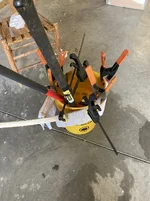
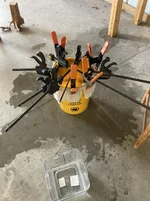
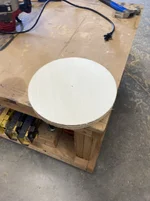
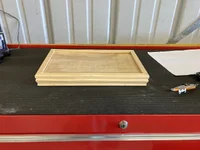
I have been inspired by everyone’s awesome planted fish bowls. I have been researching and toying around with the idea of setting one up. I was working on building a nano frag tank set up for my saltwater side and got the itch to try something. So I started building the pedestal for a fish bowl. Now down the rabbit hole, I am bending a piece of trim to wrap my 12” platform.
1 Replies
·
108 views
I completed my first AGA contest photos for the Dutch category today!
What a PITA!!! It took me a lot longer than I thought it would. Removing the tank equipment, cleaning the resulting mess, figuring out how to use a bunch of random cardboard to keep the light bleed off the camera...it was like a 4.5 hour affair for me in my cramped, sweaty office.
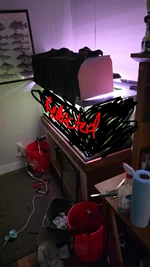
The other challenge was keeping the water clear with the filters off. Every time I thought I was ready to shoot I'd find one more leaf or stray piece of root hanging out somewhere on the surface or stuck in the moss or something. It's a lot more noticeable when the water is stagnant.
I'm glad to be done. I'm about 75% happy with how my tank turned out. Had a couple issues with plant selections but I think I made it work OK for my first entry. I'm really excited to see everyone else's tanks (and to finally start seeing them discussed on the forums). Good luck everyone!
What a PITA!!!
It took me a lot longer than I thought it would. Removing the tank equipment, cleaning the resulting mess, figuring out how to use a bunch of random cardboard to keep the light bleed off the camera...it was like a 4.5 hour affair for me in my cramped, sweaty office.The other challenge was keeping the water clear with the filters off. Every time I thought I was ready to shoot I'd find one more leaf or stray piece of root hanging out somewhere on the surface or stuck in the moss or something. It's a lot more noticeable when the water is stagnant.
I'm glad to be done. I'm about 75% happy with how my tank turned out. Had a couple issues with plant selections but I think I made it work OK for my first entry. I'm really excited to see everyone else's tanks (and to finally start seeing them discussed on the forums). Good luck everyone!
0 Replies
·
25 views


Staff member
I Donated 2026
Founding Member
The theme for this month's contest is: Algae Patina

This one is going to be tough but I hope some of you take up the challenge. There is a fine line between algae on an object that makes it look natural and old (patina) and algae on an object that simply makes it look unkept and dirty.
Who can strike that balance best??
Please take a picture of algae patina in your aquarium. Be as artistic and creative as you like.
The rules:
A $25 store credit from BurrAqua thanks to @Burr740!

Good luck!
This one is going to be tough but I hope some of you take up the challenge. There is a fine line between algae on an object that makes it look natural and old (patina) and algae on an object that simply makes it look unkept and dirty.
Who can strike that balance best??
Please take a picture of algae patina in your aquarium. Be as artistic and creative as you like.
The rules:
- Submissions are allowed between September 11 and September 23.
- Voting will start on September 23 at 12:01 am Eastern time.
- Voting will end on September 30 at 11:30 pm Eastern time.
A $25 store credit from BurrAqua thanks to @Burr740!
Good luck!
3 Replies
·
242 views


Supporting
I Donated 2026
Rockstar
Journal The Chronicles of Nano
So I've had this UNS 30C going for just over a month now and I understand why they say bigger tanks are easier. This has been a bit of a struggle. It was just my 2nd aquarium and was intended to be something simple and easy to care for. Thought I'd finally create a journal for it and chronical it's journey from the little nano that tried to hopefully, a shrimp paradise.

Tank: UNS 30C with a DIY stand.
Light: ONF Flat Nano
Original Filter: Oase Filtosmart 100 Thermo
Current Filter: Oase Biocompact 25
CO2: Fzone regulator on a Paintball CO2 tank. In-tank diffuser.
Substrate: UNS Controsoil (Fine) and ADA La Plata sand
Hardscape: Lava rock and unknown driftwood (probably spiderwood)
Testing out a cheap stainless steel skimmer I purchased off AliExpress
Plants
Multiple types of Anubias and Bucephalandra
Mini Bolbitis
AR mini (just added)
Staurogyne Repens (just added)
Pogostemon Helferi "Downoi" (just added)
Fauna
Sunkist Orange Shrimp
Planned on Chili Rasbora but that didn't go so well, so this will be a dedicated shrimp tank.

The first mistake I made with this was to plant immediately, rather than do a dark start as I did with my first scape. As you can still see in the current photo, I had a lot of Buce melt as a result of the high initial ammonia. I was hoping I would see more of a rebound by now but it's been a struggle. I also had different stem plants in the background and they struggled as well, even though they were already submersed grown plants. The current background plants were just placed in the last week and I've loaded the substrate up with more root tabs. They should be more durable but I may want to add something that gets a little taller. I also plan to fill in the melted Buce and some other bare areas with some additional Buce and Anubias. I'm dealing with some algae on the wood and the Anubias Nana Pinto, but nothing too serious.
I hoped that this would be home to Sunkist Orange shrimp and Chili Rasboras. Even though it's only 7 gallons, from previous experience with the Rasboras, I thought of school of 8 to 10 would be fine. I started with 8, but within 2 days, 5 decided to leave the tank (even with a lid covering 3/4 of the top). General water parameters were good, but I admit, CO2 may have been a little high. I moved the remaining Chilis to my larger tank were they are now happy and content. Hopefully the shrimp will begin breeding soon and I'll have plenty of tiny creatures to watch.

I generally don't like seeing equipment in the tank, so I started with a canister filter. Even adjusting valves to reduce flow, it was still too much and may even have been a contributing factor in the Chilis jumping out. Just this past weekend when replanting the background, I switched over to this tiny Oase Biocompact filter. It's only got a little course sponge wrapping a carbon sponge so the jury is still out on if it will provide enough filtration, but I imagine it will be fine with only plants and shrimp. I also added the in-tank heater (house can be a little cool in the winter) and switched from the inline CO2 diffuser to an in-tank diffuser. The skimmer is an experiment. I bought it on AliExpress to see how well it worked. My impression so far: Positive = I like the look and size, it seems to do a good job skimming, at least on this small tank. Negative = High pitched whine while running. I wouldn't run it all the time due to the sound, but if controlled to only run occasionally, it may work out well as long as it holds up.
I'll post updates as I add more plants and things mature.
Tank: UNS 30C with a DIY stand.
Light: ONF Flat Nano
Original Filter: Oase Filtosmart 100 Thermo
Current Filter: Oase Biocompact 25
CO2: Fzone regulator on a Paintball CO2 tank. In-tank diffuser.
Substrate: UNS Controsoil (Fine) and ADA La Plata sand
Hardscape: Lava rock and unknown driftwood (probably spiderwood)
Testing out a cheap stainless steel skimmer I purchased off AliExpress
Plants
Multiple types of Anubias and Bucephalandra
Mini Bolbitis
AR mini (just added)
Staurogyne Repens (just added)
Pogostemon Helferi "Downoi" (just added)
Fauna
Sunkist Orange Shrimp
Planned on Chili Rasbora but that didn't go so well, so this will be a dedicated shrimp tank.
The first mistake I made with this was to plant immediately, rather than do a dark start as I did with my first scape. As you can still see in the current photo, I had a lot of Buce melt as a result of the high initial ammonia. I was hoping I would see more of a rebound by now but it's been a struggle. I also had different stem plants in the background and they struggled as well, even though they were already submersed grown plants. The current background plants were just placed in the last week and I've loaded the substrate up with more root tabs. They should be more durable but I may want to add something that gets a little taller. I also plan to fill in the melted Buce and some other bare areas with some additional Buce and Anubias. I'm dealing with some algae on the wood and the Anubias Nana Pinto, but nothing too serious.
I hoped that this would be home to Sunkist Orange shrimp and Chili Rasboras. Even though it's only 7 gallons, from previous experience with the Rasboras, I thought of school of 8 to 10 would be fine. I started with 8, but within 2 days, 5 decided to leave the tank (even with a lid covering 3/4 of the top). General water parameters were good, but I admit, CO2 may have been a little high. I moved the remaining Chilis to my larger tank were they are now happy and content. Hopefully the shrimp will begin breeding soon and I'll have plenty of tiny creatures to watch.
I generally don't like seeing equipment in the tank, so I started with a canister filter. Even adjusting valves to reduce flow, it was still too much and may even have been a contributing factor in the Chilis jumping out. Just this past weekend when replanting the background, I switched over to this tiny Oase Biocompact filter. It's only got a little course sponge wrapping a carbon sponge so the jury is still out on if it will provide enough filtration, but I imagine it will be fine with only plants and shrimp. I also added the in-tank heater (house can be a little cool in the winter) and switched from the inline CO2 diffuser to an in-tank diffuser. The skimmer is an experiment. I bought it on AliExpress to see how well it worked. My impression so far: Positive = I like the look and size, it seems to do a good job skimming, at least on this small tank. Negative = High pitched whine while running. I wouldn't run it all the time due to the sound, but if controlled to only run occasionally, it may work out well as long as it holds up.
I'll post updates as I add more plants and things mature.

23 Replies
·
2593 views

Rockstar
Since the tanks have been in such a state of disarray, I’ve been focusing on moving everything to emersed until life sorts itself out.
How I transition from submersed to emersed depends on the growth form of the plant.
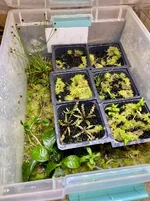
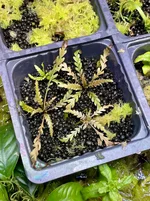
Plants that are primarily basal form (not stems) go in square nursery pots with one of two substrates. First choice is long fiber sphagnum (dried and then rehydrated) topped with aquasoil, straight aquasoil, or a mix of peat moss/perlite/coco coir/aquasoil. The sphagnum wicks better than aquasoil. Alternatively, I use straight aquasoil, I line the bottom of the pots with a coffee filter to keep the substrate from falling through. Both work equally well. The bin needs to be filled with a little more water than if dried sphagnum is used which is why the first method is preferable.
The nursery pots are kept in a clear plastic container. Sterilite are the typical go-to, but I actually prefer the tall clear shoe boxes from Walmart. They have built in ventilation holes which is handy because I need to drill holes in the sides of any other container near the lid rim. Ventilation is key.
The shoe boxes are cheap too. I fill the bins as much as possible but a little leftover space is okay.
After filling the bins with pots, I fill all the voids with live sphagnum and fill with enough distilled water to saturate the sphagnum. The sphagnum has antimicrobial properties (so I’ve read, and it seems to check out in practice). This keeps the water from developing algae almost entirely. I dress the tops with live sphagnum too if something needs a little help rooting. Depending on the space, I throw rhizome plants right into the sphagnum as well. They develop excellent root systems and are very easily removed and cleaned when needed compared to conventional soil.
I fertilize everything with a foliar spray of Maxsea 16-16-16 diluted to 1 teaspoon per gallon. It’s a kelp based fertilizer with micronutrients. I highly recommend it.
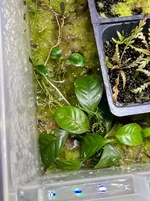
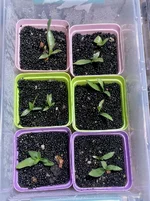
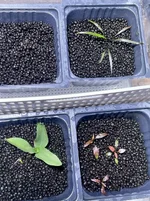
I’ll follow up with emersed stem plant propogation and other methods for the full greenhouse.
How I transition from submersed to emersed depends on the growth form of the plant.
Plants that are primarily basal form (not stems) go in square nursery pots with one of two substrates. First choice is long fiber sphagnum (dried and then rehydrated) topped with aquasoil, straight aquasoil, or a mix of peat moss/perlite/coco coir/aquasoil. The sphagnum wicks better than aquasoil. Alternatively, I use straight aquasoil, I line the bottom of the pots with a coffee filter to keep the substrate from falling through. Both work equally well. The bin needs to be filled with a little more water than if dried sphagnum is used which is why the first method is preferable.
The nursery pots are kept in a clear plastic container. Sterilite are the typical go-to, but I actually prefer the tall clear shoe boxes from Walmart. They have built in ventilation holes which is handy because I need to drill holes in the sides of any other container near the lid rim. Ventilation is key.
The shoe boxes are cheap too. I fill the bins as much as possible but a little leftover space is okay.
After filling the bins with pots, I fill all the voids with live sphagnum and fill with enough distilled water to saturate the sphagnum. The sphagnum has antimicrobial properties (so I’ve read, and it seems to check out in practice). This keeps the water from developing algae almost entirely. I dress the tops with live sphagnum too if something needs a little help rooting. Depending on the space, I throw rhizome plants right into the sphagnum as well. They develop excellent root systems and are very easily removed and cleaned when needed compared to conventional soil.
I fertilize everything with a foliar spray of Maxsea 16-16-16 diluted to 1 teaspoon per gallon. It’s a kelp based fertilizer with micronutrients. I highly recommend it.
I’ll follow up with emersed stem plant propogation and other methods for the full greenhouse.
11 Replies
·
736 views

Supporting
Expert in Residence
Rockstar
Article Contributor
Bladderwort is notoriously difficult to eradicate because even a tiny fragment can regenerate. It has the same requirements as plants, which makes it harder to selectively attack than algae.
A planted tank can be taken down, cleaned and restarted, but success seems not guaranteed due to the near impossibility of completely removing even the smallest bladderwort fragments.
Is this the final word, or are there any remedies with a reasonable success rate? Anyone could share experience?
A planted tank can be taken down, cleaned and restarted, but success seems not guaranteed due to the near impossibility of completely removing even the smallest bladderwort fragments.
Is this the final word, or are there any remedies with a reasonable success rate? Anyone could share experience?
15 Replies
·
294 views

Supporting
I Donated 2026
Rockstar
Plant Nymphoides sp. Taiwan

CO2 injected 1.4 pH drop (50 ppm per Hanna test)
Light 50-60 par at substrate
PPS-pro ferts for high tech tanks
50% water change weekly
8 dgH
0-1 dkH
7 Replies
·
779 views
