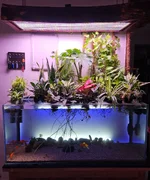
This is my goldfish tank. I usually do a 50–60% water change once a month, but not because NO3, PO4, etc. become an issue.
Even after 4 weeks, NO3 is usually around 5–6 ppm and PO4 around 0.2–0.4 ppm.
The main reason I settled on doing water changes once a month was that, at around the 4-week mark, I would usually start seeing some brown diatom algae and green dust algae.
I dose ferts daily in this tank—macros in the morning and micros in the evening.
My weekly dosing is roughly:
This time, though, I couldn’t change the water at the 4-week mark, so I just let the tank run. It has now been 6 weeks without a water change, & I’ve had no algae whatsoever.
Now, I understand that water changes aren't just about NO3 and PO4. They also help dilute/remove DOCs, hormones and other things that may accumulate over time. but i think DOCs cause diatom algae hence the appearance of diatom would mean ( for me) water change
So I basically have two questions:
1. Is there any practical way to measure DOCs in aquarium water?
If there is, I’m thinking that might give me a better idea of when the tank actually needs a water change rather than just following a fixed schedule.
2. Could I realistically stretch my water changes to once every 2 months or so?
It’s only 4 goldfish, around 3–4 inches each, in roughly 300 L of water. Nutrients don’t seem to be building up, and the tank seems perfectly fine even after 6 weeks.
What do you guys reckon? Would you be comfortable running it for 2 months between water changes?
Even after 4 weeks, NO3 is usually around 5–6 ppm and PO4 around 0.2–0.4 ppm.
The main reason I settled on doing water changes once a month was that, at around the 4-week mark, I would usually start seeing some brown diatom algae and green dust algae.
I dose ferts daily in this tank—macros in the morning and micros in the evening.
My weekly dosing is roughly:
- NO3: 8 ppm
- PO4: 2.8 ppm
- K: 40 ppm
- Fe: 0.17 ppm
This time, though, I couldn’t change the water at the 4-week mark, so I just let the tank run. It has now been 6 weeks without a water change, & I’ve had no algae whatsoever.
Now, I understand that water changes aren't just about NO3 and PO4. They also help dilute/remove DOCs, hormones and other things that may accumulate over time. but i think DOCs cause diatom algae hence the appearance of diatom would mean ( for me) water change
So I basically have two questions:
1. Is there any practical way to measure DOCs in aquarium water?
If there is, I’m thinking that might give me a better idea of when the tank actually needs a water change rather than just following a fixed schedule.
2. Could I realistically stretch my water changes to once every 2 months or so?
It’s only 4 goldfish, around 3–4 inches each, in roughly 300 L of water. Nutrients don’t seem to be building up, and the tank seems perfectly fine even after 6 weeks.
What do you guys reckon? Would you be comfortable running it for 2 months between water changes?