



What is Theodoxus? It is a large genus of freshwater snails.
Why did I decide to tell you about them? I watch a lot of aquarium videos in English, Ukrainian, and Russian, and I noticed that almost nothing is known about Theodoxus on the English-language internet. Only recently did Chris Lukhaup mention them briefly. Meanwhile, in Ukraine and in another country (which is currently bombing us), they are extremely popular.
Since I have learned a lot from the authors on this forum (Ross, Dennis, and others), I decided to thank the community in this way.
So.
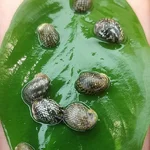
Theodoxus is a freshwater snail widely distributed in nature. I don’t know who first came up with the idea of using it in aquariums, but it is the most useful snail I have ever worked with. Essentially, it is a small Neritina, but far more effective at fighting green algae (GDA, GSA, and diatoms). They completely remove these algae, cleaning stones and Anubias leaves.
Unlike Neritina, they are very small, and their eggs are also tiny—almost invisible on hardscape. My breeding experience has been very positive: I have obtained hundreds of snails without any problems.
They do not damage plants. They don’t even eat decaying plant leaves.
In addition, they are very hardy. For example, I once sent snails from Ukraine to Spain, and they arrived alive. This is not surprising, since this species naturally inhabits European waters.
Do they have any disadvantages? Unfortunately, yes.
The most important one is that they do not tolerate soft water. It is also believed that they do not tolerate CO₂, but I have successfully kept and bred them with CO₂ injection—as long as the water was hard. In soft water, they stop reproducing, their shells dissolve, and they eventually disappear. For most aquascapers, this is a serious drawback, but for the average aquarist it is not. Tap water in Europe (and probably in the USA) is usually hard enough.
Another minor drawback is that not all individuals reproduce. I can’t say much about this, as mine reproduced without any issues in hard water. The only requirement, in my opinion, is the presence of hardscape (stones), which they cling to very firmly while cleaning.
Why did I decide to tell you about them? I watch a lot of aquarium videos in English, Ukrainian, and Russian, and I noticed that almost nothing is known about Theodoxus on the English-language internet. Only recently did Chris Lukhaup mention them briefly. Meanwhile, in Ukraine and in another country (which is currently bombing us), they are extremely popular.
Since I have learned a lot from the authors on this forum (Ross, Dennis, and others), I decided to thank the community in this way.
So.
Theodoxus is a freshwater snail widely distributed in nature. I don’t know who first came up with the idea of using it in aquariums, but it is the most useful snail I have ever worked with. Essentially, it is a small Neritina, but far more effective at fighting green algae (GDA, GSA, and diatoms). They completely remove these algae, cleaning stones and Anubias leaves.
Unlike Neritina, they are very small, and their eggs are also tiny—almost invisible on hardscape. My breeding experience has been very positive: I have obtained hundreds of snails without any problems.
They do not damage plants. They don’t even eat decaying plant leaves.
In addition, they are very hardy. For example, I once sent snails from Ukraine to Spain, and they arrived alive. This is not surprising, since this species naturally inhabits European waters.
Do they have any disadvantages? Unfortunately, yes.
The most important one is that they do not tolerate soft water. It is also believed that they do not tolerate CO₂, but I have successfully kept and bred them with CO₂ injection—as long as the water was hard. In soft water, they stop reproducing, their shells dissolve, and they eventually disappear. For most aquascapers, this is a serious drawback, but for the average aquarist it is not. Tap water in Europe (and probably in the USA) is usually hard enough.
Another minor drawback is that not all individuals reproduce. I can’t say much about this, as mine reproduced without any issues in hard water. The only requirement, in my opinion, is the presence of hardscape (stones), which they cling to very firmly while cleaning.


 So far nobody has imported them here. I know Dan'sfish.com would be interested if you wanted to work with them!


