Welcome to ScapeCrunch

We are ScapeCrunch, the place where planted aquarium hobbyists come to build relationships and support each other. When you're tired of doom scrolling, you've found your home here.

Journal SkaleyAquatics Re-attempted Dutch

So, now that AGA deadline is done I have to decide what to do with the Main tank. I am leaning towards a substrate swap, I was not a huge fan of the color of my current substrate, I prefer a darker shade. Now begs the question do I experiment with safe-t-sorb that I have on hand or go the ole BDBS route. I have been testing the safe-t-sorb in a low tech breeding tank and I really like the color of it. It also seemed to be of similar granule size to aqua soil and was easy to plant in. One downside is its a PIA to clean. Its color is very similar to that of brown aqua soil. The fish will go into a farm tank regardless of the substrate swap. I will have to be more diligent in testing parameters with the safe-t-sorb as it will pull minerals out of the water for awhile. With no deadline on the horizon I do want to experiment a bit more. I will have to decide if this will be done in a farm tank or the main tank. The one consistent I will be having is the source RO water since I only dose Ca and Mg in those, and dose the aquariums individually.

As far as farm tanks go, I have setup a 3rd on that is currently 2 weeks into its dark start while I patiently wait for my preorder to come in from cherriesna. I ordered a bunch of the crypts and just some other things I did not have to add to my collectritis. Though I am testing my hand at aquasoil in a hitech environment this time. I am hoping that I can thin the species down a bit in the other 2 farm tanks so they have a bit more breathing room to grow in. This tank will have the aquamaxxx on it for the time being until I decide to upgrade to a weekaqua p900. I do not know if I provided this in an earlier update or not but the other 2 farm tanks have 1) Week Aqua P900 and 2) Chihiros WRGBII 10th ed respectively on them now.

The mid energy cube without co2 has been a thread algae machine. I have not been doing enough water changes on it but plants are growing good for the most part. I plan to do another water change on it tonight to make it 2x a week on wc instead of one. I also am going to start introducing low amounts of macros as long term this is the plan. Here is the chart I made up with my planned solution:
1733771319835.webp
This will be my first time not dry dosing macros. I also figured I could use this mix in my low tech tanks as I know I am lacking potassium out of the tap.

Emersed plant bin I made a switch from using garden soil to just pea gravel and have a spot where a pump and heater to go for circulation and to hopefully help with the low 60s the bin has been exposed to. It is more of a hydroponic setup now and have debated adding misters to mist the plants every so often instead of just purely having there roots in water. I am sure the crypts and anubias would appreciate the misting.

While I posted this pictures elsewhere on a post I figured I would include them here:
20241206_194944.webp20241206_194951.webp20241206_195002.webp
 
Interesting. Possibly the result of iron and nitrogen limitation?
That is what I am thinking. Though there is some behind that in the back corner and does not receive as much light so it is green. So lightning plays a role as well.
 
So I was able to get my hands on a par meter. I recorded 9 spots at the substrate at 7 different power levels the corners and edges were as close as possible to the edge or corner. This light is hanging about 18" above substrate. And is offset so it sits closer to the back instead of being dead center. This is the week aqua p900 on my main tank.
1734489939553.png
I find the middle numbers to be staggering high in relation to the edges. It already has me thinking about plant placement for my next layout. I do want to grab mid-water and top-water numbers as well but will need help with inputting the numbers so it'll have to wait. I will do further test on my farm tanks and the cube to also see there numbers.

Along with that the past 3 days I have spent 3-4 hours each on one of the high tech tanks. I'll have to grab pictures for the farm tanks tomorrow as lights are off for the night. But here is the updated rescape of the main tank.
20241217_214449.jpg
I was able to get my hands on some new to me tissue cultures from tropica at about $5 a piece and a majority of them went in here for the time being as I am still struggling for space in the farm tanks. Hopefully soon I'll be able to turn the lights on on the 3rd farm tank but trying to hold out until my preorder comes in on more plants.

My emersed bin is doing great now that I swapped it over to a more hydroponic setup and places a heater and pump in there versus the potting soil.

At some point soon, I really need to setup shop to start selling plants as locally no one keeps plants like I do and am tired of pitching excess. With that in mind if you are looking for something let me know I'm upwards of 90 species of plants now, with this number going up to over 110 when my preorder comes in.

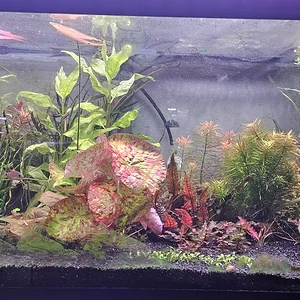
The cube tank, last week I started noticing necrosis on some of the rotala 'blood red sg'. I did start dosing the water column with low ferts but it was sporadic last week and have since corrected my error there. Still have a slow hair algae outbreak in the tank as well.
 
Last edited:
The par drop-off on the edges is real. Sometimes I have plants that grow completely differently depending on where I put them in the tank.
Correct, I referred to this a couple of time in the thread about the photone app. Not sure if I anyone would read if I explained the physics, it is probably sufficient to know that PAR variations in a tank can easily be 50 or 100%, depending on light source and optics. This also means that a plant in one location may have much different lighting condition than in another location.

All this can easily be calculated, I've done it when I was physics student. In those days I used a DEC VAX, now it would be a nice iPhone/iPad app that goes with the premium light source from an innovative manufacturer.
 
Correct, I referred to this a couple of time in the thread about the photone app. Not sure if I anyone would read if I explained the physics, it is probably sufficient to know that PAR variations in a tank can easily be 50 or 100%, depending on light source and optics. This also means that a plant in one location may have much different lighting condition than in another location.

All this can easily be calculated, I've done it when I was physics student. In those days I used a DEC VAX, now it would be a nice iPhone/iPad app that goes with the premium light source from an innovative manufacturer.
When I first started gathering my readings I thought for sure I was doing something wrong. After moving the light to different heights and different locations I determined that no I was not doing anything wrong and there was that much variance. I should also point out these readings were through a glass lid, and numbers were higher with them off but it was across the board not just one or two points.

It was pretty eye opening, and I was hoping for less spread between middle vs. he edges. I knew the corners would be lower but I was shocked by how much lower.

So I am curious in the physics aspect of this. To follow up with this does type of light play a role in these values? I am talking bar light vs puck light, I am guessing that diffusion method also plays a role and how the light refracts and reflects through and off the water also all play roles? Does T5(or other fluorescent bulbs) provide better spread vs LEDs?
 
So I am curious in the physics aspect of this. To follow up with this does type of light play a role in these values? I am talking bar light vs puck light, I am guessing that diffusion method also plays a role and how the light refracts and reflects through and off the water also all play roles? Does T5(or other fluorescent bulbs) provide better spread vs LEDs?
I guess I got myself into a rabbit hole :-) Best I can do here is to mention some basics, but it is really hard to use a post here for a more deeper understanding of optics, and besides that nobody would read it.

Optics often is quite counter intuitive, I gave some examples in the Photone app thread. People always mention that light intensity goes down by the square of the distance to the light source, which is true for a point source but generally not true for real life light sources (like light bar or light rectangle). As always it is best to use common sense because we all developed some intuitive feeling for light, but when capturing it in numbers it is best to be cautious. A measurement is always the final proof, but my point in the other thread is that it is debatable if it makes economical sense to spend big money on measurement precision with a professional PAR meter, unless we own a greenhouse and the electricity bill is a major cost factor for our commercial operation.

That light drops off significantly at the edge of a tank can be easily understood when we model a long tank with a long fluorescent light tube. When the plant is in the middle, we see the yellow light rays in the below picture coming in from the left as well as the right. Most intensity comes from the nearest position of the light tube, much less so from the parts of the tube far away. But when we then place the plant on the edge of the tank, the lower picture, we suddenly miss all the light that came from the right, and hence the intensity that the plant sees is about 50% reduced.

1734565819175.webp
I am talking bar light vs puck light, I am guessing that diffusion method also plays a role and how the light refracts and reflects through and off the water also all play roles? Does T5(or other fluorescent bulbs) provide better spread vs LEDs?
Some factors that play a role, not a complete list, for how much light a plant receives
  • LED's have "lenses" in front of the light emitting diode, that focus the light and add to a more efficient use of the light generated. The manufacturers usually measure the emission profile as a function of the angle, and that information is essential for understanding the light distribution in the tank.
  • Several light sources (fluorescent, "plasma emission", or incandescent) may use reflectors, so that light that would otherwise not go down in the tank is captured. These reflectors must be included in any calculation estimation of light intensity.
  • Tank water will reflect light at the surface, and absorb light.
  • Plants lower in the tank will be further from the light source and get less light.
  • Position in the tank, and relative to light source is key.
As a physics student I worked on ray tracing (this was actually in X-ray optics, but same principle), Monte Carlo methods for insiders. The computer shoots light rays from a light source, and calculates their path. After a few thousand light rays the big picture becomes clear, after perhaps a million one has a really accurate computational "measurement". Give a student a few months, and I am pretty sure we have a calculation engine that can tell a hobbyists light distribution for any position in a tank.

Calculating light intensity for real life tank, and a real life light source, with "pen and paper" formulas is inaccurate or impossible.
 
Now that the results have been provided I can post my FTS for the contest:MP_Kaley2024.webp
I know I lost points for the open space behind the dwarf aquarium lily, but with some issues I had the weeks prior to deadline I am overall pleased with this entry and look to improve on it next year. This was took on a phone camera, next year and all future pictures will be coming from a mirrorless camera I picked up during the holiday season.

Keep an eye out for some pretty big changes for the journal and dutch journey in the coming months.
 
Now that the results have been provided I can post my FTS for the contest:View attachment 6913
I know I lost points for the open space behind the dwarf aquarium lily, but with some issues I had the weeks prior to deadline I am overall pleased with this entry and look to improve on it next year. This was took on a phone camera, next year and all future pictures will be coming from a mirrorless camera I picked up during the holiday season.

Keep an eye out for some pretty big changes for the journal and dutch journey in the coming months.
Nice man, if that was filled in, you'd have a high score....well maybe. I guess the rules have changed šŸ˜†. The right side is sweet!
 
Nice man, if that was filled in, you'd have a high score....well maybe. I guess the rules have changed šŸ˜†. The right side is sweet!
Thanks Unexpected, it means a lot even without it being perfect. The right side came together extremely well. It looked better with the h. corymbosa but mysterious melt. Let me see if I can dig up a picture of it with the hygro.
 

Top 10 Trending Threads

Back
Top