Welcome to ScapeCrunch

We are ScapeCrunch, the place where planted aquarium hobbyists come to build relationships and support each other. When you're tired of doom scrolling, you've found your home here.

Share your Laterite and Substrate Mix Experiences

Joined
Jun 21, 2025
Messages
206
Reaction score
235
Location
United States
I did always end up having better results with plant growth by mixing substrates rather than using 1 solo by itself.
This even goes the same for using super rich substrates like APT-FEAST.

Even adding a very thin layer of foxfarm ocean forest potting soil or worm castings underneath (1-2cm MAX) always improved plant growth, vigor and size.
The only reason I've stopped doing this is because you cannot use a thick substrate with this method and the tank seems extremely prone to BBA overtime.


Laterite -
seems to be another one that I'm not sure on. I do realize the iron probably isn't absorbed by plants just because its locked up in a form plants can't access, but the fact that using a substrate with such a high "magnetism" must change the tank ecosystem in some way no?
 
I have used DIY substrates in my last two tanks and put a lot of thought into them, but I'm not sure that I have any real breakthroughs to share. They seem to be working, but not with a notable growth advantage. Like, it's fine. Definitely cheaper than aquasoil alone though.

I did want to talk about laterite though, because I don't understand why it was ever all the rage. Now, the term "laterite" is itself a bit squishy, but everything I have ever learned about very weathered tropical clays (what the USDA soil taxonomy calls oxisols - a large umbrella, but should include anything we're calling a laterite as I understand it) is that they are a pretty bad starting place for agriculture. Obviously if you live in the tropics you have to work with what you have, but why would we buy it for a premium?? Less weathered clays have better CEC , more intact base cations, less aluminum, and might be much more freely available depending on where exactly you live. Why didn't we use those? Maybe I'm missing some context here, but I don't get it at all. (I assume the real answer is that laterite had marketing. behind it and people are scared to just go get dirt from their yard.)

As for the availability of iron, plant roots can manipulate the chemistry in the rhizosphere to fix that, either directly or indirectly through mutualistic relationships with microbes. This requires a plant to be left alone long enough to grow a root system and not just rely on the water column, and some species are just better at it than others. In terrestrial plants you often see species that evolved on acidic soils are very terrible at extracting the iron they need as the pH creeps up, presumably because they never needed to have that skill before. I haven't looked to see if that trend holds up in aquatic plants, but I wouldn't be surprised.
 
I’ve mainly done mixes since I started. I was very into using DIY soil mixes, and the last few scapes were soil capped with sand and they worked well. My current setup is as you described, APT Feast capping a thin layer of soil/peat/worm castings. That strategy in the past worked well, plants grew great.
 
Which mixes did you try? The real one with the
I’ve mainly done mixes since I started. I was very into using DIY soil mixes, and the last few scapes were soil capped with sand and they worked well. My current setup is as you described, APT Feast capping a thin layer of soil/peat/worm castings. That strategy in the past worked well, plants grew great.
Did u find these tanks extremely prone to black brush algae if you made the bottom a bit overly thick, like 1-2inch of organic base.

That was my results nearly every single time. But a thinner layer works extremely well.
they seem to benefit a ton from a thinner layer of substarte, like 1.5-2 inch total substrate depth.

My understanding is that that's the depth that oxygen can still reach and keep the tank relatively in good shape, any deeper or if the substrate is too fine you get instability issues.
 
Haha, courtesy of the Internet Wayback Machine! From 1995, at the height of the Dupla domination era 😁 😅


Ha, you know, I have read this previously and then memory-holed it because it doesn't have a consensus view. Lots of opinions bouncing around, little agreement. It seems that including laterite gave people better plant growth than using sand and gravel, and there have been some mixed results when people ventured outside of Dupla-brand laterite, including inferior plant growth and clouding, but that might just come down to how they process that specific product rather than an inherent advantage of lateritic soils. Did Dupla add fertilizer? That would certainly boost growth, lol. There is lots of talk about iron content, but again, other clays are likely to have more iron and less aluminum. I also question exactly how much iron we need in the substrate to begin with. I believe that some is better than none, but do we really need "as much as possible"?

As much as I hate the little ball texture of aquasoil, it isn't messy and it doesn't compact - two big issues with DIY soil mixes. Putting substrates in mesh baggies solves the first issue entirely, though in my experience dirted substrate become less messy over time anyway. For the second issue I've limited the percentage of compactable materials, padding them out with stuff like old aquasoil, calcined clay (Safe T Sorb), and small bark particles. I've also let my mixes mature a bit after making them - this gives any highly volitile organic matter time to break down, and also loose aggregates begin to form, making pores and channels that allow water passage through the soil... in theory. This works for terrestrial soil, but I have no idea how these aggregates hold up when submerged. I haven't run into any issues with hydrogen sulfide in a substrate with soil 3.5" from the top of the substrate at least.
 
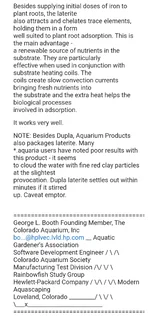
Interesting that George Booth claimed it's main function in conjunction with heater cables was to somehow chelate trace minerals in the root Zone

View attachment 18767

Have not found his source for that claim 🤔🤔
In that first sentence sounds like he's just trying to describe ion exchange? (Very weathered clays can have some anion exchange capacity which is kind of neat, but easily dwarfed by CEC in other soils.) They don't chelate, but they attract and hold. As for the heating coils promoting soil water movement, well, I'm sure if it made a big difference we'd still have them.

I asked their chatbot, it said no 🤣
Oh, ok, that settles it then! :ROFLMAO:
 
Which mixes did you try? The real one with the

Did u find these tanks extremely prone to black brush algae if you made the bottom a bit overly thick, like 1-2inch of organic base.

That was my results nearly every single time. But a thinner layer works extremely well.
they seem to benefit a ton from a thinner layer of substarte, like 1.5-2 inch total substrate depth.

My understanding is that that's the depth that oxygen can still reach and keep the tank relatively in good shape, any deeper or if the substrate is too fine you get instability issues.
Never had any BBA issues unless my co2 wasn’t right. I used to pour in the soil 2-3”, cover it with erosion fabric to keep the soil down and covered it with either blasting sand or pool filter sand. Those setups did well but eventually ran out of nutrients, about a year or so in. I’ve only ever done co2 scapes, not low tech like some do with “walstad” style setups.
 

Top 10 Trending Threads

Back
Top