I've been experimenting with autodosing for a while! I really like large weekly water changes, like 70%+, but learning how to create a setup that kept fertilizer levels consistent hasn't been easy.
I use Chihiros auto dosers and the new GHL Doser 3 to daily dose my tanks.
I created my
Accumulation Calculator to help show consumption levels in tanks.
My thoughts and findings:
In low-energy tanks, (1.0ppm
NO3 consumption per day or less) front-loading is
great (using
ppm NO3 as a proxy for all macros):
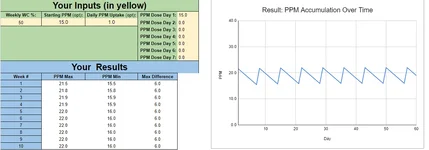 None of this needs auto-dosing. 50% WC, an initial dose of macros at 15ppm NO3 after WC, and your tank will probably run great. Co2 injection and high light not necessary.
And in middle-to-higher-energy tanks (2.5ppm NO3 consumption per day) with larger water changes, adding more via not only extra dosing, but a midweek booster dose really helps keep things consistent:
 Still easy to dose, just one 20ppm dose after WC and on3 10ppm dose midweek. Can be done manually, or with an autodoser.
However, in really high energy tanks (say, 3.5ppm NO3 consumption per day, which my tanks were reaching with enough plant biomass) front-loading wasn't capable of keeping things stable:
 A single front-loaded dose, with large weekly WC, causes massive 21ppm swings front-loading in a high energy tank. Yikes! This would cause unhappy plants, and therefore algae, for sure.
 Even splitting the dose into two doses still had a large 10.5ppm swing or more through the week. It helps a lot, but at 3.5ppm consumed per day, it's hard to keep up without increasing the frequency of dosing through the week.
However, if you ONLY daily dose macros without some front-loading included after large water changes, it causes it's own swings:
Let's say you have a low-ish-energy tank, and you daily dose your macros, but don't do any front-loading after 50% water changes:
 Dosing 3ppm NO3 per day still has a ~9ppm swing. Macros are also pretty low. With aquasoil this would be fine, with inert substrates this might not be enough to maintain some plant's health.
But what about only daily dosing in a high-energy tank?
Dosing 3ppm NO3 per day still has a ~9ppm swing. Macros are also pretty low. With aquasoil this would be fine, with inert substrates this might not be enough to maintain some plant's health.
But what about only daily dosing in a high-energy tank?
 Not so bad in terms of weekly swings, but the actual ppm concentration in the water would only work with aquasoil-based tanks. Inert substrate tanks would really struggle with NO3 levels this low, in a high energy system.
Here's what I've been testing: what if you combined the 3 concepts? (Large water changes, initial front-loading, AND daily dosing near/above consumption levels):
 Now we're talking! In a high-energy tank that consumes a ton of nitrates (3.0ppm per day), you can still have extremely stable levels over time despite large water changes, by including an initial 18ppm NO3 dose after the weekly 70% WC.
So far in my testing, this really has been the "best of all 3 worlds".
Now we're talking! In a high-energy tank that consumes a ton of nitrates (3.0ppm per day), you can still have extremely stable levels over time despite large water changes, by including an initial 18ppm NO3 dose after the weekly 70% WC.
So far in my testing, this really has been the "best of all 3 worlds".
- With large weekly water changes, you keep lots of DOCs from accumulating, as well as having more confidence in mathematically resetting your nutrient balances should something be a bit off. You also remove all sorts of proteins and micro-molecules that may accumulate over time.
- With an initial front-loading dose, you keep your macros from ever dropping too low, and helping re-fertilize the water column after the large WC.
- With a daily dose, you can aim to be around (or, I recommend, just higher than) your daily consumption levels.
With this system, if your consumption levels are 2.0ppm/day, just dose 2.5ppm/day with a front-loading dose after large WC and your levels will stay super consistent.
Because this system also balances daily dosing with consumption levels, you can actually test these levels across the week to see what your daily consumption levels are.
For example:
- I perform a large WC on Sunday, front-load the macro dose, and let it sit for an hour to reach stability. Then, test the NO3 level (with something like the Hanna Nitrate Checker). Say it tests 24ppm NO3.
- At the end of the week, test your nitrates. If they're risen to 30ppm NO3, you know your daily dosing was slightly higher than the consumption rate. I'd leave the dosing there, since it's always better to be slightly higher than lower.
- If, at the end of the week, your nitrates test 16ppm NO3 and you notice less pearling from plants (This happens in an inert substrate system, not so much with aquasoil) then you know your daily dosing rate was below the daily consumption rate.
Perform your water change, add an initial front-loading dose to the new water, then set your daily dosing rate to whatever you think is best.
I've been doing this with a ton of success in both of my inert sand tanks:


Shoutout to
@Burr740 for convincing me that inert substrate systems may inhernetly need a higher concentration of macros in the water column. For a while I was aiming for something along the lines of 15ppm NO3, 3ppm
PO4, and 20ppm
K. It wasn't until I raised those numbers to more like 25ppm NO3, 6ppm PO4, and 35ppm K that I saw better success. Again, you really may not need such concentration with aquasoil tanks, but I've seen the results for myself!
Some of the drawbacks of this system include that you are relying on accurate dosing from your pumps, as well as accurate known concentrations of fertilizers in your dosing bottles, and a fairly accurately known water change volume removed/added. You might also need to do some testing of NO3/PO4/K over time to make sure you've got it right, but once you've got it right it really just hums along.
I do love that I don't have to dry dose each week anymore. In fact, I just type numbers into the app on my phone and the dosers dose the rest, whether that's for front-loading or daily dosing. Making one large bottle of macro ferts from dry salts is super each and cheap. I just "top off" the dosing bottles as necessary.