Welcome to ScapeCrunch

We are ScapeCrunch, the place where planted aquarium hobbyists come to build relationships and support each other. When you're tired of doom scrolling, you've found your home here.

Journal Experimental / learning tank with inert substrate

  • Thread starter Thread starter Aquajack
  • Start date Start date
  • Tagged users Tagged users None
Joined
Jul 6, 2025
Messages
114
Reaction score
186
Location
Gold Coast, Australia
I've been consuming tons of information from this amazing forum and decided its time to start my own journal.
One, to get constructive criticism/suggestions on how to improve which would be most welcome and two, just to show other approaches to starting a new tank as everyone thinks a bit differently and to see other peoples perspective.

I only started using pressurised CO2 about 18 months ago so haven't been in the hobby that long.

The first pic below was of said attempt starting with CO2. The other reason for showing that tank is I'm using the same physical tank and also starting off the new setup with plants from that tank.

Speaking of the tank, as you will see in the first pic of the new build it is an old second hand rimmed tank with less than stellar glass. In my list of planned upgrades one of them will be to order a low iron rimless tank so I can actually appreciate what's inside it. I can never get a photo to show a clear shot of the tank. Its not a great tank but it is definitely clearer than what the photos show. I think the camera really highlights how crappy the glass is lol.

No direct inspiration here apart from including a reasonable amount of hardscape and probably having a more nature style tank, so not so formal.

I've had a large piece of driftwood hanging around that I've wanted to use in a scape. I've used it previously in a larger tank but was a fish only tank. I do know after a year submerged (tied down) it still went straight to the top when released/untied so is basically unsinkable. Not sure of the type of wood though.

I also cut it in half depth wise as it was too large for a 4 foot tank.
After trying to glue it to rocks around it etc I filled the tank...and of course all went to hell. The driftwood wanted to get to the surface so bad it broke away from the glue LOL. So I had to start the scape with a large rock sitting on it and the driftwood in a different position from where it started. Temporary at first but now I plan to cover the rock with epiphytes etc so it should be ok eventually, just not so much right now. One of those it is what it is. I'm only playing around here anyways.

I'll also say, as per the heading of this journal, I'm treating this as an experimental tank, not even close to a show tank. I'll purchase a nice tank when I think I'm at a level where I deserve to bring it justice so not yet. Hopefully this tank will bring me a long way towards that point.

I've only previously used organic soil capped with sand (so the classic dirted tank). That provides good growth for around 6 months or so but if a lot of the organics start rising up and leaching into the water column, its not such a great setup for high tech tanks. Ask how I know!

I've never used aqua soil. I would like to try one day but for now decided to skip that and go straight to inert. Encouraged purely by some of you on here that have been using BDBS . That is what I would like to have used but not readily available in Aus so I'm using pool filter sand for this rendition.

Apologies for the rambling, onto the details.

Started around 5th January, did the full changeover from the old setup

Tank size:
  • 122 cm x 47 cm deep x 45 cm high (uhmm so in imperial 48" x 18.5" x 17.5")
  • Litres/gallons - 258 litres / 68 Gallons

Filter
  • Just what I have on hand and had been using in the tank (Aqua One Nautilus 1100) so around 290 G/H so of course in reality a lot less than that. Only filled mainly with sponges though, limited the bio media.
  • I have a perfectly working FX5 sitting in the shed gathering dust but I think too powerful for this size tank. That connected to a Yugang reactor though and one inch lily pipes could be a good combo. Will have to think about that for the future.

Wave maker / power head
- Aqua One 8000 reef sim (apart from obviously to help circulation - was mainly put in here to help with the CO2 distribution - so is now situated at the opposite end of the tank to the filter outlet/inlet) Flow from 528 G/H to 2113 G/H. Have it on the lowest setting and probably still too strong

CO2
  • Aqualabs Pro dual stage regulator (recently added this, replacing a cheap chinese one from ebay - about 6 times the cost!)
  • Aqualabs inline diffuser
  • Gets to around 45 ppm but I need to do some more refined testing ( I only have the JBL CO2 kit but seems to be working ok)
  • CO2 starts 3.5 hours before lights start and 4 hours before lights build up to their set level.

Water
- Tap (GH 7 KH 6), PH is around 7.6-7.8 out of the tank - at the moment

Substrate
- Pool filter sand only

Lighting
  • Week Aqua L1200 (using Red preset at R - 64%, G - 71% B - 44% and UV - 90%) TBH not sure the UV light does much but it is what it is.
  • So the lights aren't on that high, I started off the tank even lower but crept it up to what it is now.

Initial plant list (as mentioned just selecting some from previous iteration of this tank)
  • MC as the front carpet
  • Hygrophila corymbosa (restricted this quite a bit as it grows too fast with direct CO2 access) so hidden in the opposite corner to CO2 lol
-Blyxa Japonica (one of my favourite plants. Its easy to grow but I wish it would grow maybe slightly slower so it doesn't start to take over it surrounds)
  • One amazon sword - I wanted to keep one in here to prove you don't need rich substrate
  • Crypt wendtii brown - similar to above
  • Ludwigia repens
  • Helanthium bolivianum 'Quadricostatus (I think thats what it is or similar. produces runners like nothing on earth but a nice looking plant. Thats the one in the back right corner in the first photo of the new setup)
  • AR Mini
  • Hydrocotyle tripartite mini
  • Limnophila Aromatica

I've deliberately not used what i call starter plants to kick it off as I find they can take over easily in a high tech tank, then you have to gradually rip them all out. I know a higher risk of more algae without them but lets go!

Ferts
  • DIY Macros and micro mix - Rexolin APN (dosed for water tank volume)
  • Started 9/2/20 now 10/2.5/20 (yes I know quite low for an inert substrate compared to most and will gradually increase this in time)
  • Front load around 50% Macros, then the rest dosed throughout the week - only just started this method to try and limit the swings during the week
  • Micros dose evenly throughout the week adding up to 0.45 fe / week

Water change
- Currently around 55% weekly (I will be refining this a bit more too. I have a TDS meter now so will be working out exact water change volume using Rocco's TDS method which will also help with refining the fert dosing)

Current fish list

  • Around maybe 15 Rummy nose
  • 4 SAE's
  • Couple of oto's
  • 4 Corys
  • 6 Crimson spotted Rainbows ( i received these in a swap, plants for rainbows )

I plan to gradually increase the rainbow collection a bit too over time. Love the Boseman's

Other miscellaneous stuff
  • Fluval SK400 surface skimmer (seemed like a little toy when I first set it up but does an ok job actually)
  • Aqualabs pro skim lily pipes, and added quick release to the filter hosing to get to these easily. They are glass.
  • Inkbird wifi heater control


Upgrades planned
  • RO/DI - Just received but need a few more bits and pieces then I'll introduce the RO water over a 4 week period (25/50/75/100). I plan to remineralise to around 5dGH (4:1 for CA:MG), wont be adding any dKH , again following you guys lead here. I think this will be a huge upgrade as my tap water is sourced from a creek and is inconsistent. PH varies between 7 and 8 and KH has risen from 4 to 6 over the last few months.
  • CO2 reactor - Looking at the Yugang of course. This will also I think make a big difference compared to inline diffusers. When setting up the tank I put in some work to try and determine the best flow to maximise CO2 distribution but still think I haven't got it right.
  • New tank - as mentioned above
  • Possible auto fert doser for the next tank


Ferts uptake and adjusting over time:
  • The NO3 seems to provide a consistent 10 ppm before each water change which is the same amount I'm dosing now. Coincidence or is it only using what's readily available in the system. I know with slower growing plants and not a huge plant mass the uptake is obviously less.
  • PO4 - similar story, test (which I'm not sure how accurate it is) seems to provide a consistent result of 2 ppm, again similar to what I have been dosing.
  • I'll gradually increase both and see where I can find the sweet spot but may wait mainly till after the RO/DI is running.

My initial aim is to try and avoid the infamous diatom stage by using a slightly reduced light schedule and ferts to start the tank.

First impressions for me is the driftwood is too large for this tank but it is a different piece so will persevere whilst in this tank.

Anyways the pic of the tank before I pulled it down;
PXL_20250908_090910242~2.webp

Start of the new scape.
PXL_20260102_075140026.webp
You can really see the crappy condition of the tank here with the scratches, water stains etc. I'm not too bothered though. It will make me more look forward when I eventually get a nice tank.

Just after filling up and initial planting. You can see the big heavy rock on the right. Without it, the driftwood shoots all over the place.
PXL_20260105_084840781.MP.webp
Noting that entire lot of MC melted soon after this, it wasn't in the best condition when it started though. Hoping it will eventually start up again. I'm patient, uhmm kind of!
 
Updates.

Oh I forgot to say there are tons of lava rock under the sand in the back half contained in mesh bags so there are no deep pockets of sand either.

One thing I have avoided is the diatom stage somehow. There is other algae of course including green string algae across the MC and more recently a heavy dose of GDA on the glass.

For all I know, even though the macros aren't bottoming out based on end of week readings, the plants may not have full access to what's left? I just don't necessarily like too many coincidences. Particularly after seeing the levels of macros some are adding in for inert substrate tanks.

I will continue to take a tempered approach though and try and keep everything as consistent as possible. Also only trying to change one thing at a time. So when I am introducing the RO water, I'll probable keep everything else stable.

New plant list ordered and planted about a week and a half ago
  • Limnophila Hippuridoides (emersed)
  • Bacopa salzmanii purple (emersed)
  • Ludwigia Cuba (emersed)
  • Hyptis Laciniata (emersed)
  • Syngonanthus Macrocaulon (submersed)
  • Pogostem Erectus (emersed)
  • Ludwigia super red (emersed)
  • Ludwigia Acuata (emersed)
  • Hygrophila Lancea Araguaia (emersed)
  • Limnophila Vietman (emersed)

I was a bit premature ordering some more plants already before the system got settled but I figured the earlier I get them in the quicker they can /melt/adjust and regrow according to my environment. I should have waited till I switched over to RO/DI but only decided on the latter after plants were ordered.

MC all melted 100%. I grew it really easily in the old setup and although slowly growing back its much more pedestrian than what I had before but this is an experiment and I think two things are contributing to this slow uptake for MC, being slightly lower light but more likely way less ferts as the old MC had the full benefit of organic soil. However, it was getting flooded with GSA towards the end though.

GDA on the glass has really picked up. Its easy to clean and would still much rather it on the glass than the water column at this stage.

So plants are growing slowly and not all looking spectacular I know, AR Mini i'm looking at you for one!

Anyway some more updated pics:

About 3.5 weeks in.
PXL_20260201_093607369.webp

About 39 days after starting
PXL_20260214_092101455.webp

Oh and here is my 150g farm tank I can use as an extra resource to drop in spare plants etc
PXL_20260216_081155308.webp
 
Straight after i added the 10 new plants - just more than a week ago. After a water change hence the bubbles on the front glass.
I'm waiting to see how the new emersed plants melt etc.

PXL_20260221_095826779.webp

....and here are a couple pics of what the current state is like
PXL_20260228_094534129.MP.webp

PXL_20260228_094638465.MP.webp
PXL_20260228_094601104.MP.webp
Again after a water change from yesterday
PXL_20260228_094718548.MP.webp
 
What a great start to a journal! 😁😁

I wish my farm tank looked that good 👍😎

still went straight to the top when released/untied so is basically unsinkable

One thing I've had some luck with on big pieces of driftwood, check out ebay.com.au for large pieces of drilled slate, ask the sellers if they can drill additional custom holes for you.

A couple of fat pieces of slate screwed onto the bottom of big driftwood go a long way to saving your sanity. Easy to bury in substrate, and much more permanent than gluing to wood surfaces that are going to progressively decompose over time 💯💯
 
Last edited:
What a great start to a journal! 😁😁

I wish my farm tank looked that good 👍😎


One thing I've had some luck with on big pieces of driftwood, check out ebay.com.au for large pieces of drilled slate, ask the sellers if they can drill additional custom holes for you.

A couple of fat pieces of slate screwed onto the bottom of big driftwood go a long way to saving your sanity. Easy to bury in substrate, and much more permanent than gluing to wood surfaces that are going to progressively decompose over time 💯💯
Thanks Koan, that 150G is kind of doubled up as a farm tank and fish tank (its full of tiger and other bars along with some clown loaches and bristlenose)

Nice idea on the slate. Like the thin profile too. I'll keep that in mind for the next build.
 
Bit of an update, it probably hasn't even changed that much looking at it from 4 weeks ago, but I've trimmed/chopped down a lot, particularly blyxa, I've taken out so much of that. You may not think looking at the latest pick but was starting to smother/take over other plants particularly on the left.

Of the emersed plants I've added maybe 70% have continued on ok, just starting to adjust more now.

AR mini is one plant that struggles a bit for some reason.
There is still a few plants mostly hidden but I need more room lol. That size driftwood was a bit of a mistake as it takes up so much real estate. But I'll persevere with it for now. I'm treating this as a learning tank anyways and fine tuning equipment etc.

Last shots before I add RODI. I'll gradually introduce over 4 weeks, with the aim to bring down the dGh to around 5 and dKH to 0-1. Currently 8 & 6. Really looking forward to see what changes will occur once implemented. Everything else I'll keep the same for a while.

Just focusing on stability, lighting hasn't changed lately, either has CO2 and nutrients are stable as I'll ever have them (50% front loading after 50% W/C then spread the rest over the next 5 days . Currently at 12/2.7/26 & 0.45 Fe. Will definitely look into the auto dosers before this experiment is done. May need to increase light gradually and also ferts but one thing at a time. Only short light period of 7 hours which includes half hour ramp up and down and not on that strong either.

Also have a flow meter on order. CO2 will be my next target to improve. I like to do things gradually and methodically though but I'll get there in the end.

Still getting plenty GDA on the glass by the end of the week and bits of GSA on the MC (which to be honest is not flying along - maybe it does move quicker with a rich substrate, not sure).
PXL_20260328_081252166~2.webp
PXL_20260328_083746831.webp
PXL_20260328_083707524.webp
PXL_20260328_083646639.webp
PXL_20260328_081408961.webp
 

Attachments

  • PXL_20260328_081357726.webp
    PXL_20260328_081357726.webp
    401.8 KB · Views: 8
  • PXL_20260328_081345194.webp
    PXL_20260328_081345194.webp
    331.1 KB · Views: 7
Nice journal. It'll be interesting to see how the plants take to the big change in water parameters during the changeover to GH-remineralised RO. I guess some plants may be quite shocked and take quite a while to adjust. Whereas for others, a 4 week transition may be enough to not affect them too much.

Another Blyxa-lover here too. It does grow like a weed when its happy though ! I'd say mine probably doubles in mass in around a week when it gets going.

When I converted my 150g to a planted tank I started out with loads of wood and rocks, as that was what i was used to. Over the months I became more and more resentful of the real estate space it was taking up, which could have been taken by plants. I now have no wood and only a couple of small rocks. Lol ! I wonder how long you will tolerate that monster piece of wood ?
 
Nice journal. It'll be interesting to see how the plants take to the big change in water parameters during the changeover to GH-remineralised RO. I guess some plants may be quite shocked and take quite a while to adjust. Whereas for others, a 4 week transition may be enough to not affect them too much.

Another Blyxa-lover here too. It does grow like a weed when its happy though ! I'd say mine probably doubles in mass in around a week when it gets going.

When I converted my 150g to a planted tank I started out with loads of wood and rocks, as that was what i was used to. Over the months I became more and more resentful of the real estate space it was taking up, which could have been taken by plants. I now have no wood and only a couple of small rocks. Lol ! I wonder how long you will tolerate that monster piece of wood ?
Thanks. I think you have a similar mindset to me. To be honest I only included that large piece of wood as it was sitting in the garage for ages and wanted to see what it was like in a scape. However, I'm more resenting it now and it literally does take up half the tank which is a LOT of real estate.

The other factor with that driftwood is it dictates to a degree the flow of CO2. (an area I need to improve). I have a wave maker at the opposite end of the filter where the CO2 is disbursed but not sure at this stage whether its helping or hindering.

I'm only starting to consider the fact that even though long term I think the RO water will be a huge improvement on my current tap water, in the short term it will be a change which will disrupt the stability of the tank so expect either a bit of plant melt whilst adjusting and /or some GSA. Will be interesting either way. All good for the learning curve though.

Also, as you mentioned, that space could be taken up by plants. I've had to squeeze them in for now but will look to release more real estate a bit later. I'm happy to keep the rocks as they break up the scape a bit without taking up huge amounts of room.

I also have a 150 planted tank but I consider that half a planted tank and half a fish tank as its full of barbs and clown loaches. Half consider it a farm tank too lol to dump all my extras but that too has run out of room, and all the cuttings from that are meant to go where? lol
 
Looking good! And as a fellow also with a big chunk of wood in my tank, keep it! We need more hardscape representation going on lol.😂
<3 blyxa japonica, I have one little stem hiding behind a rock and I’m dying to let it out to cover my mid ground entirely.
Here is an older pic from a 150G which has blyxa covering the foreground if you want to know how it goes. I think I must have had most of the lights off when I took the pic. It is a bit dark but you get the picture, pardon the pun.PXL_20250908_091632313.webp
 
Nice tank(s) and even nicer presentation of in-depth details! I havent absorbed all of the information here, just a quick couple of points:

Point one
Emersed and TC plants have a lot of die off in the beginning while they are converting. Pretty much every leaf they arrive with is gonna either die, or just sit there abandoned while the plant siphons nutrients out of them to fuel the new growth. Just about every algae we encounter eats the by-product of decaying/degraded plant leaves. Algae doesnt eat NO3, PO4 etc. It eats this. Both at the source (the unhealthy leaf) and in the water from what unhealthy leaves leech into it

Algae doesnt come in and attack unhealthy leaves. Unhealthy leaves literally create the algae. They are not weak victims to it. They are the source

Food source present - algae appears and thrives
No food source - algae dies or doesnt show up in the first place

This is the critical point to understanding where algae comes from to begin with and how to get rid of it

It is especially difficult to start a brand new tank using mostly emersed or tc plants. Because they bring a full course all-you-can-eat buffet of algae food with them

You want healthy thriving plants right from the jump. The more the better to minimize the issues associated with new tanks

Point two
You seem to be very hesitant to have any extra nutrients to the water. This is wrong thinking for any tank but especially with inert substrate. Excess macro nutrients will cause literally zero problems. Starving/unhealthy plants cause most of them. Point one above explains why

So it would benefit you tremendously to think about this differently. You want to err on the side of having too much instead of not enough. Forget what the test readings say. That data means nothing. What do the plants say?

Having 5 ppm in the water doesnt mean plants have had enough and thats the leftover, or that they can even get it. It doesnt work that way with macros and Ca/Mg. There HAS to be a certain baseline concentration present. For the same reason we shoot for 30-40 ppm Ca. An ultra high-energy stem-packed tank might only use 2-3 ppm Ca per week. But good luck running one with just that much

Nobody blinks at having 30 ppm unused Ca in the water. Macro nutrients should be viewed the same way, especially with inert sub. Healthy plants is ALL that matters. Everything depends on that one factor
 
Last edited:
Nice tank(s) and even nicer presentation of in-depth details! I havent absorbed all of the information here, just a quick couple of points:

Point one
Emersed and TC plants have a lot of die off in the beginning while they are converting. Pretty much every leaf they arrive with is gonna either die, or just sit there abandoned while the plant siphons nutrients out of them to fuel the new growth. Just about every algae we encounter eats the by-product of decaying/degraded plant leaves. Algae doesnt eat NO3, PO4 etc. It eats this. Both at the source (the unhealthy leaf) and in the water from what unhealthy leaves leech into it

Algae doesnt come in and attack unhealthy leaves. Unhealthy leaves literally create the algae. They are not weak victims to it. They are the source

Food source present - algae appears and thrives
No food source - algae dies or doesnt show up in the first place

This is the critical point to understanding where algae comes from to begin with and how to get rid of it

It is especially difficult to start a brand new tank using mostly emersed or tc plants. Because they bring a full course all-you-can-eat buffet of algae food with them

You want healthy thriving plants right from the jump. The more the better to minimize the issues associated with new tanks

Point two
You seem to be very hesitant to have any extra nutrients to the water. This is wrong thinking for any tank but especially with inert substrate. Excess macro nutrients will cause literally zero problems. Starving/unhealthy plants cause most of them. Point one above explains why

So it would benefit you tremendously to think about this differently. You want to err on the side of having too much instead of not enough. Forget what the test readings say. That data means nothing. What do the plants say?

Having 5 ppm in the water doesnt mean plants have had enough and thats the leftover, or that they can even get it. It doesnt work that way with macros and Ca/Mg. There HAS to be a certain baseline concentration present. For the same reason we shoot for 30-40 ppm Ca. An ultra high-energy stem-packed tank might only use 2-3 ppm Ca per week. But good luck running one with just that much

Nobody blinks at having 30 ppm unused Ca in the water. Macro nutrients should be viewed the same way, especially with inert sub. Healthy plants is ALL that matters. Everything depends on that one factor
Thanks so much @Burr740 for your considered reply and makes perfect sense. The other mistake I made with this new tank is the MC I used from an old tank was not in the best of shape as was riddled with GSA so kept the best bits and chucked the rest before I started but still not ideal for starting off. Another tick box to add to my list for when I eventually start a show tank. Lots of healthy submersed grown plants to start off.

One thing I have been trying to do is continually remove old/deteriorating leaves but will increase my effort on that to try and reduce/eliminate sources of algae.

Considering I'm using inert substrate I guess the macros are quite low. I should have seen the direct effects of that in my previous tank which was organic soil capped with sand. That substrate has a high nutrient value and was only moderately dosing the water column. Plants grew like crazy for 6-8 months, then they didn't. The organics started pushing to the top of the substrate and leaching into the water column, and I didn't start increasing the water column dosing accordingly (in other words both of the issues in one form or another mentioned above started to appear). I'll be honest I didn't know exactly what was happening at the time but is so clear looking back now.

OK, even though I do value stability, I'll start slowly increasing macros week by week, maybe 10-15% per week. What has been a good dosing level to target for an inert substrate tank with a fair amount of plants and 50% water changes per week? (30/8/35) or similar?
 
Good deal. Personally I would just do it all at once. Ramping is still a bunch of changes, just small ones. You dont have any plants that will take it too hard. At worst a couple stems species might stunt the existing top, but they'll immediately throw new side stems that are re-wired for the new conditions. Thats what the stunting is, the plant adjusting itself

I'll go out on a limb and say nothing you have will. Its a response that is more common going down in ferts than up

Macros doing 50% water changes Id do about 18-20/5-7/25-30 per week

Fyi I like to front load half the weeks total doing 50%. The last couple years, while working out the details for my retail macros, such as how much a dose is, and how often/how much to suggest based on different "energy" level tanks, I stumbled upon the perfect formula for front loading macros with the purpose of keeping baseline levels as steady as possible through the week, specifically avoiding the big post-wc drop during the first part of the week

  • The Formula: is whatever % water change youre doing, front load the same % of the weekly macros total right after. Id been doing 75-80% for years, frontloading most of the weeks total, saving a little for mid week. To develop my retail macros I had to be doing everything like everybody else is gonna be doing, using my own "suggested dosing" in all my own tanks. Its the only way I could put it on a label with full confidence. Digressing...

So Ive been doing 50% again for almost 3 years, along with front loading half the macros. (Micros dont need any adjustments like this, period. Ever) It has been noticeably and by far the best macro routine Ive ever used

  • How you can apply it: Make your macro solution where a single dose adds 1/4 of the desired weekly total

Example for 18 ppm NO3 per week, a single dose would be 4.5 ppm (4.5 x 4 doses = 18) Do the same for PO4 and K

Then just make the post water change dose a double (add 2x single doses) Thats half the weeks total and you have 2 more single doses to add through the week in regular 3x week fashion
 
Good deal. Personally I would just do it all at once. Ramping is still a bunch of changes, just small ones. You dont have any plants that will take it too hard. At worst a couple stems species might stunt the existing top, but they'll immediately throw new side stems that are re-wired for the new conditions. Thats what the stunting is, the plant adjusting itself

I'll go out on a limb and say nothing you have will. Its a response that is more common going down in ferts than up

Macros doing 50% water changes Id do about 18-20/5-7/25-30 per week

Fyi I like to front load half the weeks total doing 50%. The last couple years, while working out the details for my retail macros, such as how much a dose is, and how often/how much to suggest based on different "energy" level tanks, I stumbled upon the perfect formula for front loading macros with the purpose of keeping baseline levels as steady as possible through the week, specifically avoiding the big post-wc drop during the first part of the week

  • The Formula: is whatever % water change youre doing, front load the same % of the weekly macros total right after. Id been doing 75-80% for years, frontloading most of the weeks total, saving a little for mid week. To develop my retail macros I had to be doing everything like everybody else is gonna be doing, using my own "suggested dosing" in all my own tanks. Its the only way I could put it on a label with full confidence. Digressing...

So Ive been doing 50% again for almost 3 years, along with front loading half the macros. (Micros dont need any adjustments like this, period. Ever) It has been noticeably and by far the best macro routine Ive ever used

  • How you can apply it: Make your macro solution where a single dose adds 1/4 of the desired weekly total

Example for 18 ppm NO3 per week, a single dose would be 4.5 ppm (4.5 x 4 doses = 18) Do the same for PO4 and K

Then just make the post water change dose a double (add 2x single doses) That's half the weeks total and you have 2 more single doses to add through the week in regular 3x week fashion
Perfect thanks again. That wont be too much of an adjustment for me then. I recently changed the weekly dosing volume to break it into 4, although admittedly that was only to make the front loading 50% straight forward. I'll kick those numbers into gear next week then. Oh, I would buy your ferts but 8,000 miles maybe a little too far to ship lol.

Your formula makes mathematical sense too and as I see it the only way to minimize disruption to nutrient numbers after a water change. How the remainder is allocated throughout the rest of the rest is maybe not as important as long as non-limiting but splitting that up into two is less labour intensive than my current daily.

The same philosophy of course could be applied to the transition from tap to RO water which I've started. I'm only taking a few weeks for that due to livestock.

Once those couple of changes are fully implemented and have had a chance to settle in and take effect I'll report back.
 
Bit of an update after a rough week on the tank. Had a leaking cannister filter for the whole week.

So twice a day I would have to stop the cannister, empty the container it was in and restart. One day I stopped the CO2 whilst I attempted to fix it.....and of course forgot to flick the switch on the power to the solenoid for a day and a half 😕 Anyways I think I've finally fixed it. Replaced the main o-ring in the head unit, ensured all o-rings had silicon lube and that still didn't quite fix it, but after pulling it apart again yesterday its now OK.
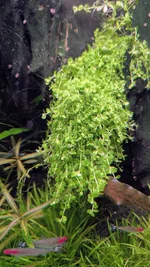
However, in the meantime, I went searching for an alternative filtering solution that was more likely to be stable long term and where I had full control. Based on a recent thread The Great Big Filter Thread and the discussions around DIY solutions, I've gone for the netlea pre-filter + DC pump solution. Thanks @Naturescapes_Rocco for showing us all that innovative solution. So I have 2 x Neltea G2 pre-filters on order + a Jebao 6000 L/H DC smart pump. Can't wait till that all comes in and I can undertake some testing etc to refine the flow. This will almost certainly give me better options in terms of configuration inside the filter, MUCH better flow than this old filter I'm currently running, which with an in-line diffuser will make a large difference to CO2 distribution. It will also allow me to fine tune the flow down the track when I replace the diffuser with a reactor.

Also, yesterday was the first full water change with 100% RO water. Really happy with that system. Changing around 55% of water volume per week.
Only slight mistake I made was when I mixed in the MGSO4 & CASO4, I added a bit of water, then mixed it up but left it there for 5 min or so instead of pouring straight into the aquarium. So there was a thin layer left in the container afterwards. Maybe a portion of the CASO4 didn't hydrate fully? Anyways learnt my lesson there, next time I'll have the dry mix ready, mix it up with a small electric mixer/milk frother thing I have on hand, then pour it straight in front of the filter flow, or water change hose.

I buy the MGSO4 & CASO4 from the same place I buy the other dry ferts from, (in Aus we don't seem to have a lot of options in that regard) but seems pretty expensive to me. CASO4 is $6 for only 200 grams & MGSO4 is $5 for 250 grams. Maybe I can just by gypsum and epsom salt in larger quantities for cheaper?

Anyways, finally, the other change is increasing my ferts. I couldn't do it fully to my target straight away as I've needed to finish off the last mix I made. I've increased it as much as I can without increasing the PO4 & K too much so its close but basically, I'll be looking at 18/5/25 - that's for the whole tank volume and 50-55% water change (50% of macros upfront, then then 2 x 25% portions during the week). Micros 0.45 fe. Oh and I remineralise to 5dGH (using water change volume), I don't try to increase KH.

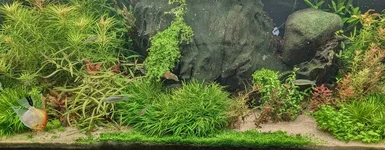
Current pic, sorry was taken during the day and CO2 in full force but you get the picture.
PXL_20260419_042413276~3.webp
 
Bit of an update after a rough week on the tank. Had a leaking cannister filter for the whole week.

So twice a day I would have to stop the cannister, empty the container it was in and restart. One day I stopped the CO2 whilst I attempted to fix it.....and of course forgot to flick the switch on the power to the solenoid for a day and a half 😕 Anyways I think I've finally fixed it. Replaced the main o-ring in the head unit, ensured all o-rings had silicon lube and that still didn't quite fix it, but after pulling it apart again yesterday its now OK.
However, in the meantime, I went searching for an alternative filtering solution that was more likely to be stable long term and where I had full control. Based on a recent thread The Great Big Filter Thread and the discussions around DIY solutions, I've gone for the netlea pre-filter + DC pump solution. Thanks @Naturescapes_Rocco for showing us all that innovative solution. So I have 2 x Neltea G2 pre-filters on order + a Jebao 6000 L/H DC smart pump. Can't wait till that all comes in and I can undertake some testing etc to refine the flow. This will almost certainly give me better options in terms of configuration inside the filter, MUCH better flow than this old filter I'm currently running, which with an in-line diffuser will make a large difference to CO2 distribution. It will also allow me to fine tune the flow down the track when I replace the diffuser with a reactor.

Also, yesterday was the first full water change with 100% RO water. Really happy with that system. Changing around 55% of water volume per week.
Only slight mistake I made was when I mixed in the MGSO4 & CASO4, I added a bit of water, then mixed it up but left it there for 5 min or so instead of pouring straight into the aquarium. So there was a thin layer left in the container afterwards. Maybe a portion of the CASO4 didn't hydrate fully? Anyways learnt my lesson there, next time I'll have the dry mix ready, mix it up with a small electric mixer/milk frother thing I have on hand, then pour it straight in front of the filter flow, or water change hose.

I buy the MGSO4 & CASO4 from the same place I buy the other dry ferts from, (in Aus we don't seem to have a lot of options in that regard) but seems pretty expensive to me. CASO4 is $6 for only 200 grams & MGSO4 is $5 for 250 grams. Maybe I can just by gypsum and epsom salt in larger quantities for cheaper?

Anyways, finally, the other change is increasing my ferts. I couldn't do it fully to my target straight away as I've needed to finish off the last mix I made. I've increased it as much as I can without increasing the PO4 & K too much so its close but basically, I'll be looking at 18/5/25 - that's for the whole tank volume and 50-55% water change (50% of macros upfront, then then 2 x 25% portions during the week). Micros 0.45 fe. Oh and I remineralise to 5dGH (using water change volume), I don't try to increase KH.

Current pic, sorry was taken during the day and CO2 in full force but you get the picture.
View attachment 16255
Do you have a brewing supplies place nearby? That is where I get mine, about $6 for 500g.
If not, then Kegland should have both Ca and Mg and they post anywhere in Australia.
 

Top 10 Trending Threads

Back
Top