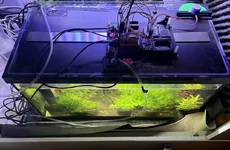
Hi @Yugang, thank you for sharing your idea about increasing the co2 in air of the hood of a tightly closed lid tank. I understand the rationale behind it. It would greatly reduce the amount of CO2 needed.
Some things come to mind. Indeed diffusion into the water and it’s equilibrium with the aquarium hood’s CO2 will be temperature dependent. But that’s not a showstopper I guess, mere a factor to take into account.
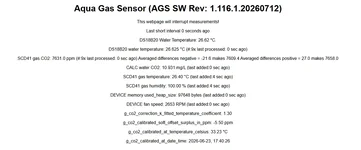
My current experience with the CO2 sensor model SCD41, it needs regular calibration, at least when operating for precision in in low ppm ranges. It is very simple though, just put it outside for 10-15 minutes and push a button, but still.
I’m not sure the drift is relative or absolute. If it is absolute, drift might not be a big factor.
A possibly big downside of the method would be for me, I can’t open the the aquarium hood/lid often, the CO2 would escape. One could mitigate this by pumping a lot of CO2 in the hood, but being able to release a lot of co2 in a short amount of time would greatly increase health risks for our tank and maybe ourselves (for instance when a check valve hangs, measurement is incorrect or required CO2 is computed incorrect.
What I like about a CO2 Bell and a horizontale reactor and its overflow mode though, is the “set and forget” method. Low dependency on (measuring or precision dosing) technology (which tend to be unstable and/or drift and/or break down) for a specific level of CO2 in the water column.
But I do agree, the idea is worth being tried out. I’m not a fan of pressurized CO2 canisters though (again thinking about what happens when all CO2 is released at once stops me from having one), so I might want to try it out with yeast based CO2, which might be sufficient. Any overproduction can be mitigated by 2 solenoids and/or a simple air pump. A small plant only tank would be perfect for a try out.
Currently too busy with other stuff, but again, thank you for posting the idea. Note to self is .
.
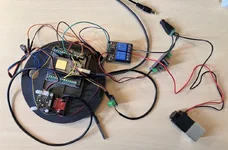
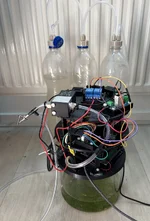
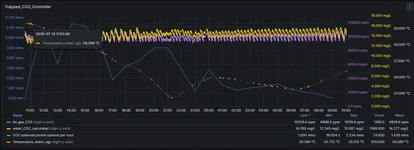
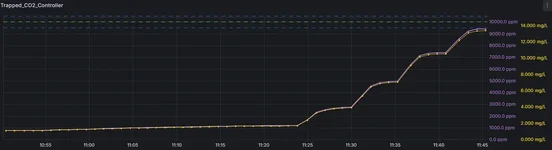
Inspired by a thread on another forum, I’ve built and running an aerial CO2 (and oxygen) sensor in a gas pocket, functioning as a digital drop checker, for water CO2 monitoring purposes. So I’m familiar with the technology which I assume is required.I am not capable to build the electronics with the sensor, nor do I have the space to set up a test tank. If someone is interested to test the idea, it won't be expensive or complicated, that would be great. I am 90% confident it will work, but the proof is in the real experiment.
Some things come to mind. Indeed diffusion into the water and it’s equilibrium with the aquarium hood’s CO2 will be temperature dependent. But that’s not a showstopper I guess, mere a factor to take into account.
My current experience with the CO2 sensor model SCD41, it needs regular calibration, at least when operating for precision in in low ppm ranges. It is very simple though, just put it outside for 10-15 minutes and push a button, but still.
I’m not sure the drift is relative or absolute. If it is absolute, drift might not be a big factor.
A possibly big downside of the method would be for me, I can’t open the the aquarium hood/lid often, the CO2 would escape. One could mitigate this by pumping a lot of CO2 in the hood, but being able to release a lot of co2 in a short amount of time would greatly increase health risks for our tank and maybe ourselves (for instance when a check valve hangs, measurement is incorrect or required CO2 is computed incorrect.
What I like about a CO2 Bell and a horizontale reactor and its overflow mode though, is the “set and forget” method. Low dependency on (measuring or precision dosing) technology (which tend to be unstable and/or drift and/or break down) for a specific level of CO2 in the water column.
But I do agree, the idea is worth being tried out. I’m not a fan of pressurized CO2 canisters though (again thinking about what happens when all CO2 is released at once stops me from having one), so I might want to try it out with yeast based CO2, which might be sufficient. Any overproduction can be mitigated by 2 solenoids and/or a simple air pump. A small plant only tank would be perfect for a try out.
Currently too busy with other stuff, but again, thank you for posting the idea. Note to self is
.